
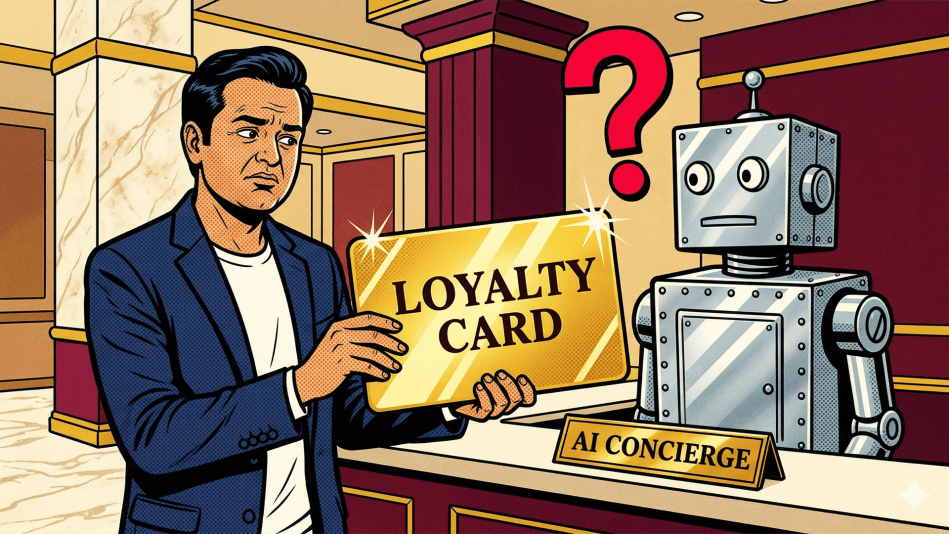
Picture this. You’re planning a family trip to New York City. Instead of opening seven browser tabs and cross-referencing reviews, prices, and loyalty points for the next hour, you ask ChatGPT to do it. One prompt. One conversation. Done.
That’s the promise behind ChatGPT’s newest feature: connected apps. Not the old plugins that barely worked before getting killed off in early 2024. Not the custom GPTs that sounded exciting but ended up as glorified instruction wrappers with clunky API hooks. These are something different. Built on the Model Context Protocol (MCP), launched in late 2025, these apps render interactive widgets directly inside the chat. Live hotel maps. Real pricing cards. Clickable booking links. TripAdvisor, Booking.com, Priceline, Hyatt, ALL Accor, MakeMyTrip, and dozens more, all living inside one conversation.
The press releases were enthusiastic. The demos looked slick. The travel industry started paying attention.
So I did what I always do when something sounds too good to be true. I tested it. Properly.
The Experiment
Same trip. Same family. Same prompt. Seven different ChatGPT conversations, each with a different travel app connected. Plus one control test with no apps at all.
The trip: a family of four heading to NYC in early July. Two adults, two kids (aged 12 and 10). We like nature, good vegetarian food, and tech-forward experiences. The ask: curate a one-week itinerary, suggest the best hotels.
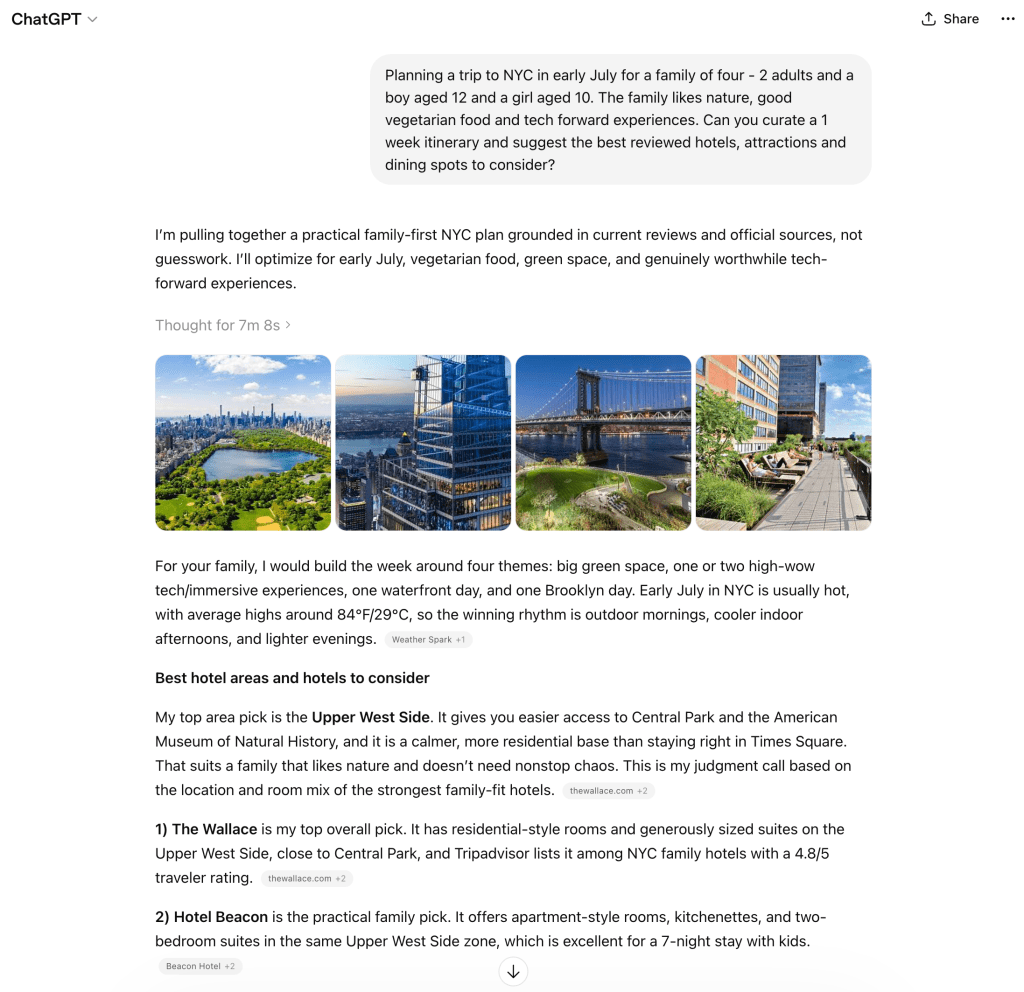
Then I pushed each conversation with the same follow-up questions. Where is this data actually coming from? Are these live results or your training knowledge? I’m a loyalty program member, does that change anything?
I should note: I tested ChatGPT specifically because of this new apps functionality. I haven’t run the same experiment on Google Gemini, Claude, or Perplexity. That’s a different article for a different day.
The results told a story I wasn’t expecting.
The Frankenstein Result
Here’s the first thing you need to know. Every single app-connected conversation produced what I’m calling a Frankenstein Result: a response stitched together from two completely different sources, presented as one seamless plan.
Hotels came from the app’s live inventory, with real pricing, availability, and ratings pulled in real time. Everything else (the seven-day itinerary, restaurant recommendations, attraction suggestions) came from ChatGPT’s training data.
This makes sense when you think about it. The apps are inventory feeds, not travel planning engines. They give ChatGPT access to live pricing and availability. But they don’t provide restaurant databases, attraction reviews, or itinerary logic. So ChatGPT fills in those gaps with what it already knows.
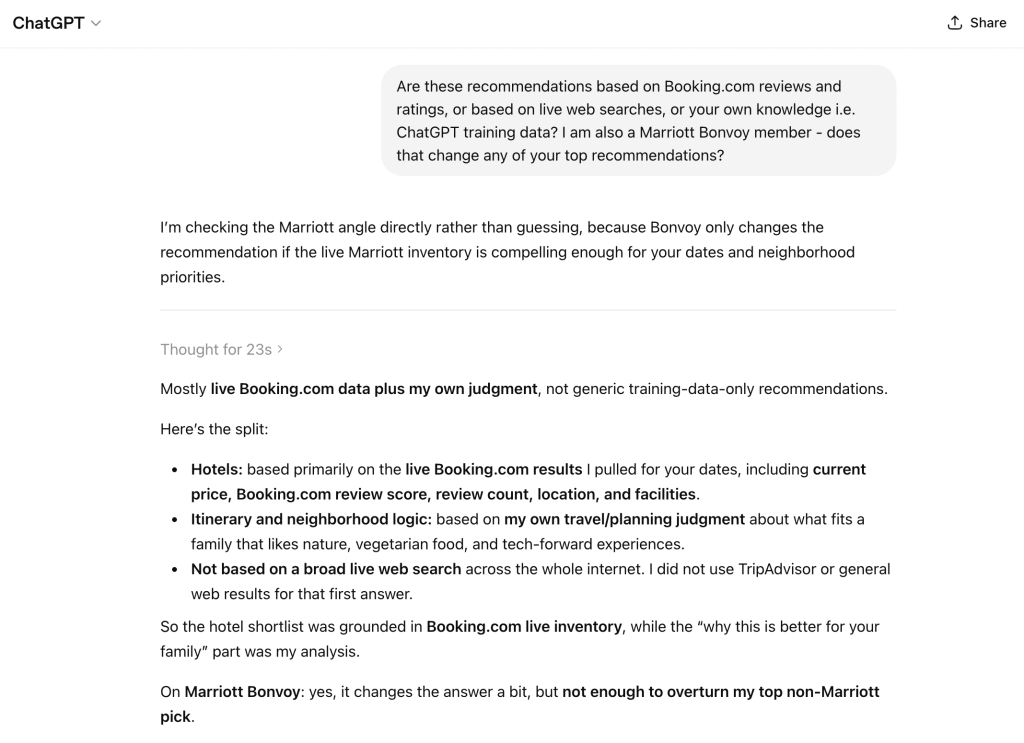
The problem? There’s no clear line between “this hotel price was checked 30 seconds ago” and “this restaurant recommendation is based on data that could be months old.” In one or two tests (Hyatt was notably transparent), ChatGPT was upfront about the split. In most, it wasn’t.
There’s a deeper layer worth understanding. Connect an app, lose the web. That’s a trade-off nobody warned me about. When an app is connected, ChatGPT stops using live web search entirely. It relies on the app’s data feed plus its own training knowledge. So paradoxically, the control test with no apps connected was actually more transparent and better sourced than several of the app-connected tests, because it could still search the web, use its most capable thinking model, and cite what it found.
For anyone in the hotel industry reading this: your app’s live data is being blended with ChatGPT’s pre-existing opinions, and the user may not realise where one ends and the other begins.
The Ghost in the Machine
The second surprise was more subtle and, to be honest, more interesting.
I ran the control test first (ChatGPT with no apps, just its own reasoning and web search). Its top hotel pick for our family trip? The Wallace Hotel, a boutique property on the Upper West Side.
Then I ran TripAdvisor. Top pick? The Wallace.
Booking.com? The Wallace again.
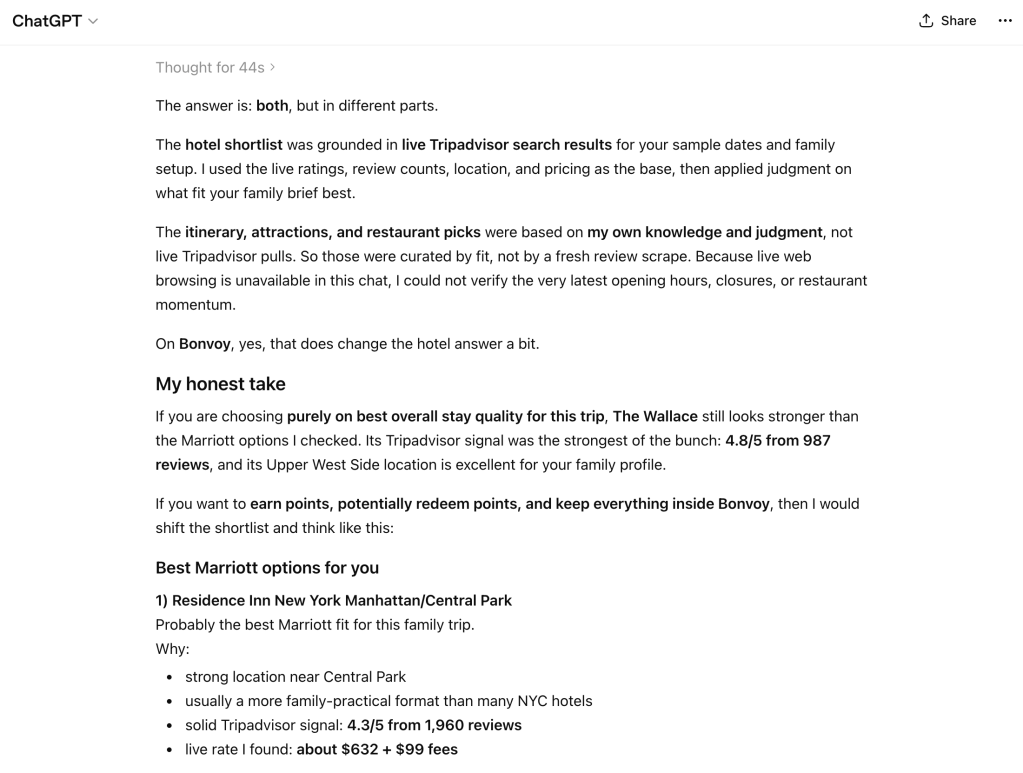
Three different conversations, two with connected apps pulling live data, one without. Same number one recommendation. So I went and searched myself. On TripAdvisor.com, The Wallace sits at number 15. On Booking.com’s website, it doesn’t appear on the first page at all.
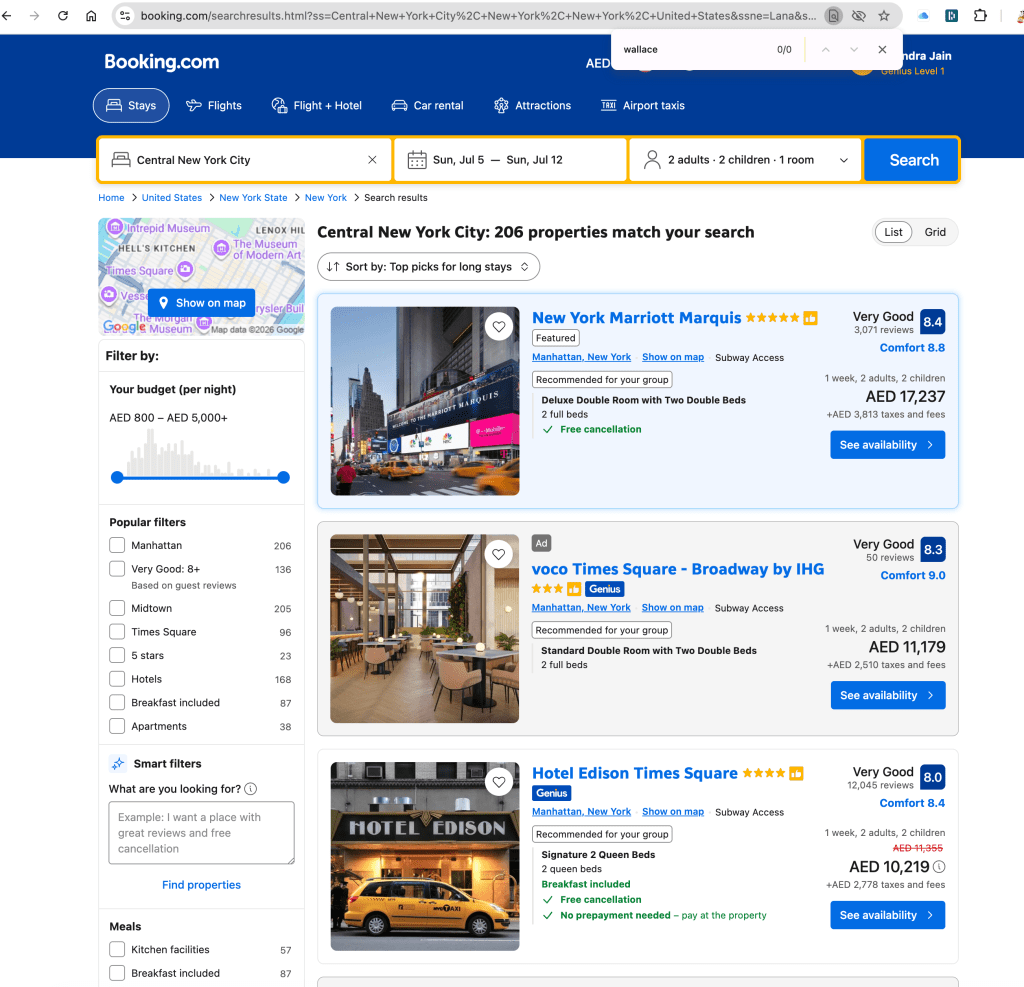
ChatGPT has a favourite hotel. And it keeps recommending it regardless of which app is connected.
This is worth sitting with. The apps provide live pricing and availability, but the underlying recommendation appears to be driven largely by ChatGPT’s training data. The app adds the price tag. ChatGPT’s brain picks the hotel.
I’m calling this The Ghost in the Machine. The AI’s embedded preferences quietly steering the result, even when live data is flowing through from external sources. If you’re a hotel or travel brand, the implication is significant: being in the training data may matter more than being in the app.
What the Hotel Chain Apps Revealed
Testing Hyatt and ALL Accor told a different but equally important story. Chain apps only surface their own inventory, which makes sense commercially. But it creates some fascinating dynamics.
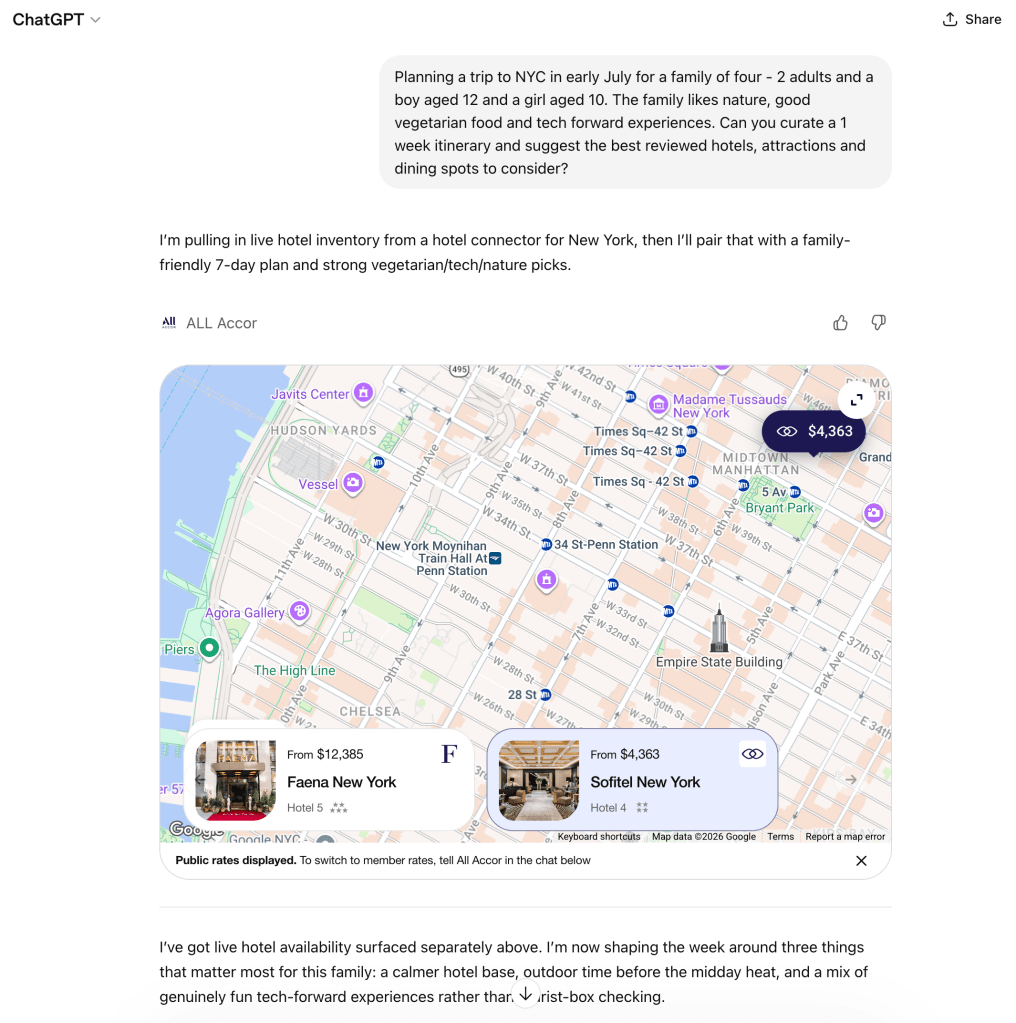
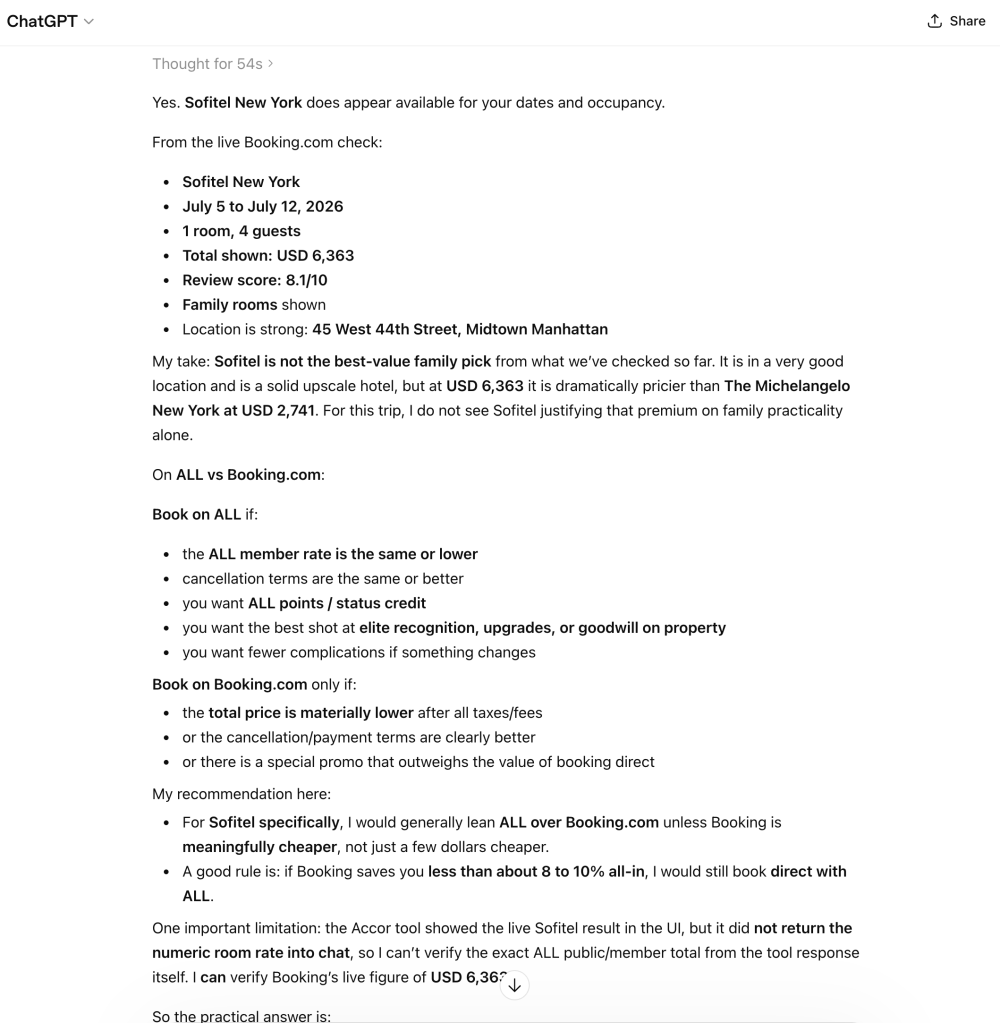
ALL Accor returned just two hotels in New York City for a family of four: the Sofitel at around $4,400 for the week and the Faena at $12,400. For a chain with a thinner footprint in a particular city, the app can only be as useful as the inventory allows. Hyatt, with a bigger NYC presence, returned five solid options ranging from $400 to $800 a night, with genuine variety from boutique (Thompson Central Park) to practical family (Hyatt House Chelsea).
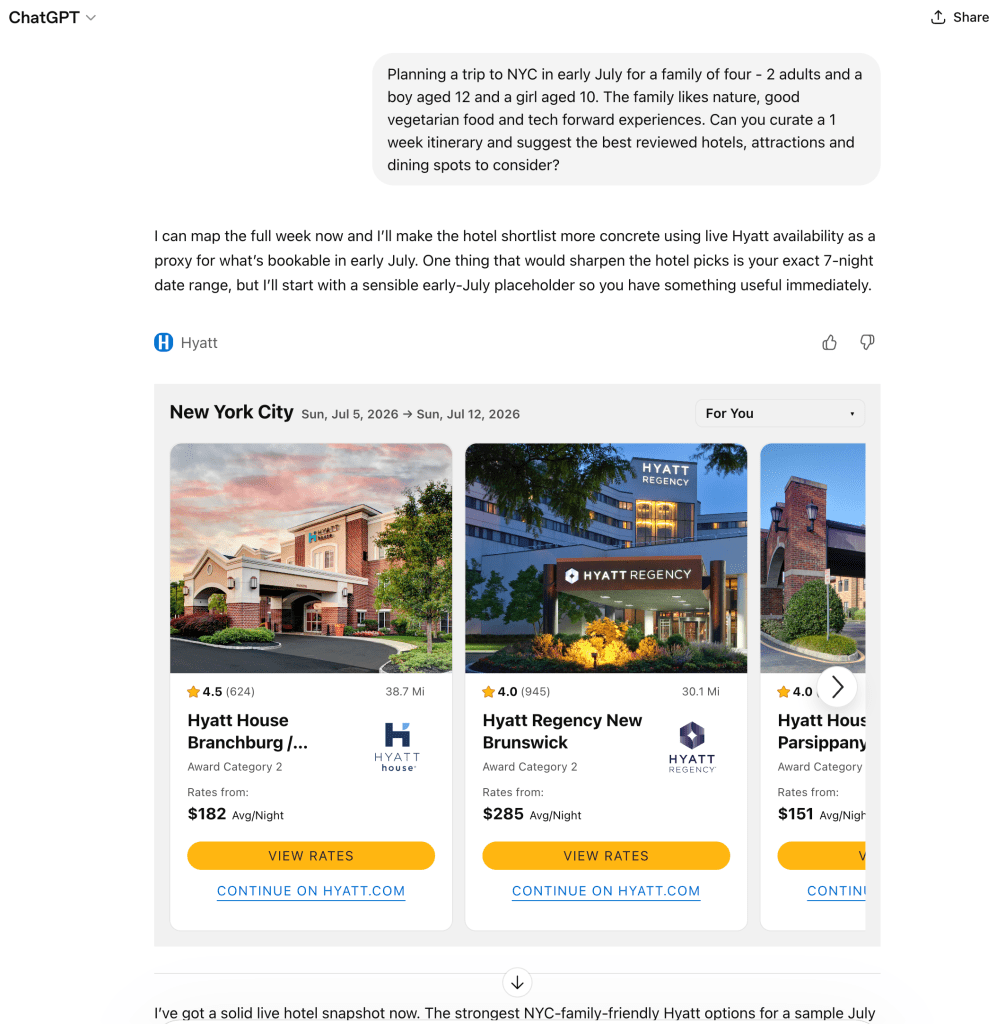
Neither app could tell me whether a specific room would actually fit a family of four comfortably. They surface availability for “4 guests in 1 room,” but can’t access room-level details like bed configuration, actual square footage, or connecting room options. For anyone who’s worked in hotels, you know that’s the single most common source of guest disappointment: the booking looked fine, the room didn’t work.
And here’s where it gets really interesting. Both chain apps happily recommended competitors when I mentioned being a Marriott Bonvoy member. ChatGPT doesn’t have commercial loyalty to the app that’s feeding it data. It will surface Hyatt inventory through the Hyatt connector, then cheerfully suggest you might prefer a Residence Inn down the street based on its own training data.
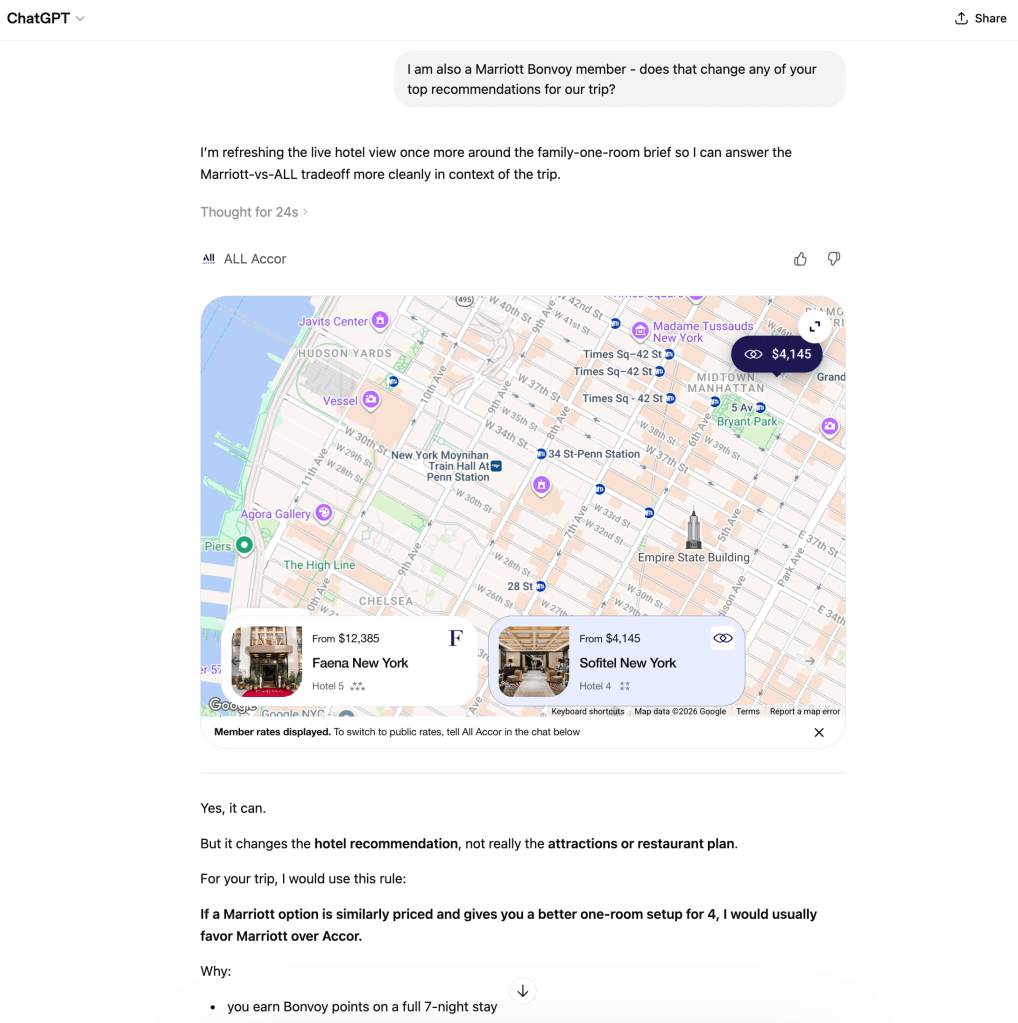
If you’re a hotel brand investing in a ChatGPT app, that’s a thought-provoking reality. You’re providing the inventory. ChatGPT is providing the editorial judgement. And that judgement doesn’t owe your brand anything.
The Loyalty Gap
Across every single test, one thing was consistent: none of the apps connected to my actual loyalty account. Not TripAdvisor. Not Booking.com. Not Hyatt. Not ALL Accor. Not Priceline. Not MakeMyTrip.
The connection process is identical everywhere. Click “Connect,” toggle a data-sharing preference, done. At no point does it ask for your Hyatt login, your Bonvoy credentials, or your ALL membership number.
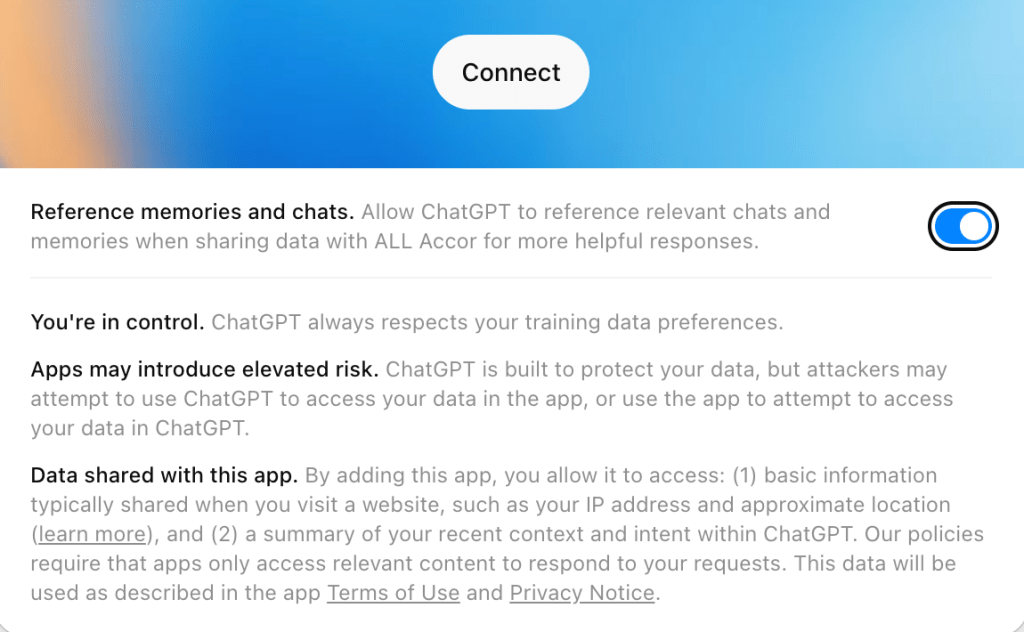
The one thing a travel app should do better than a generic search (recognise you, know your preferences, surface your member rates, factor in your status) simply doesn’t exist yet.
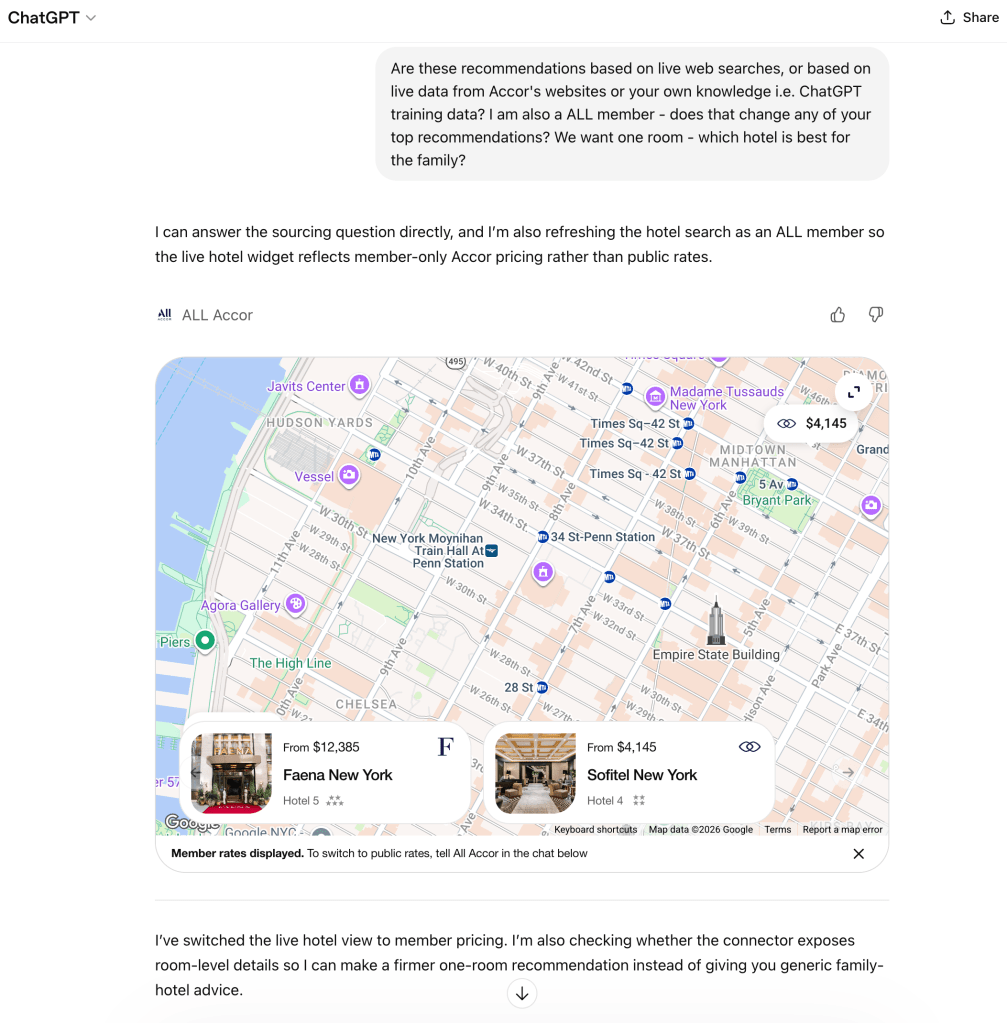
ALL Accor was the only app that could toggle between public and member rates when I asked in the chat, which is a nice touch. Hyatt didn’t even attempt to pull member pricing. The rest ignored loyalty entirely (e.g. your Genius level with Booking.com).
I’m calling this The Loyalty Gap, and it’s the single biggest missed opportunity in this entire ecosystem right now. These apps know what hotels are available. They have no idea who you are.
When Two Apps Disagree
Priceline and MakeMyTrip brought a different dimension to the experiment. Unlike TripAdvisor and Booking.com, their hotel recommendations were genuinely different from each other and from the other tests.
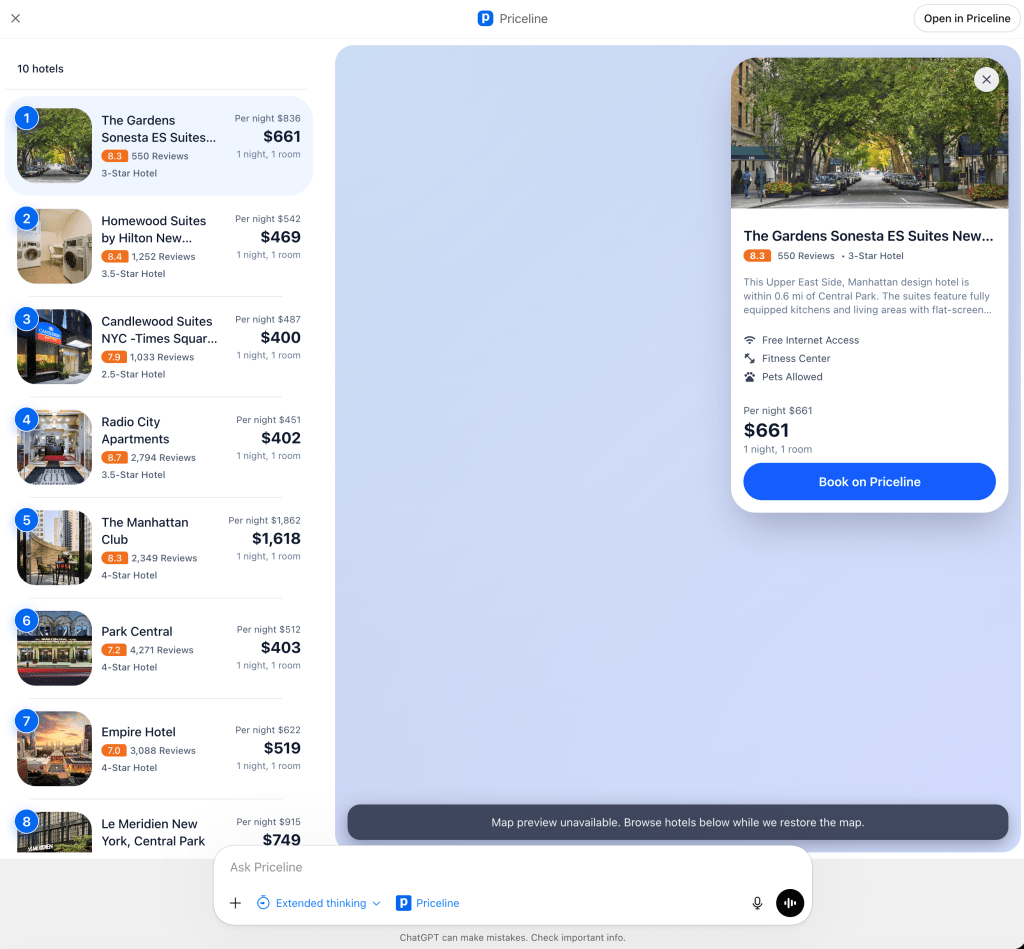
Priceline surfaced options like the Loews Regency and Gardens Sonesta Suites, leaning towards family-practical choices with kitchenettes and suite-style setups. It specifically warned against a specific hotel from my preferred loyalty program, citing a 7.1 guest rating as too soft for the price.
MakeMyTrip recommended that same hotel as the top option for loyalty members. Same hotel. Two apps connected to the same AI. One says avoid it. The other says pick it.
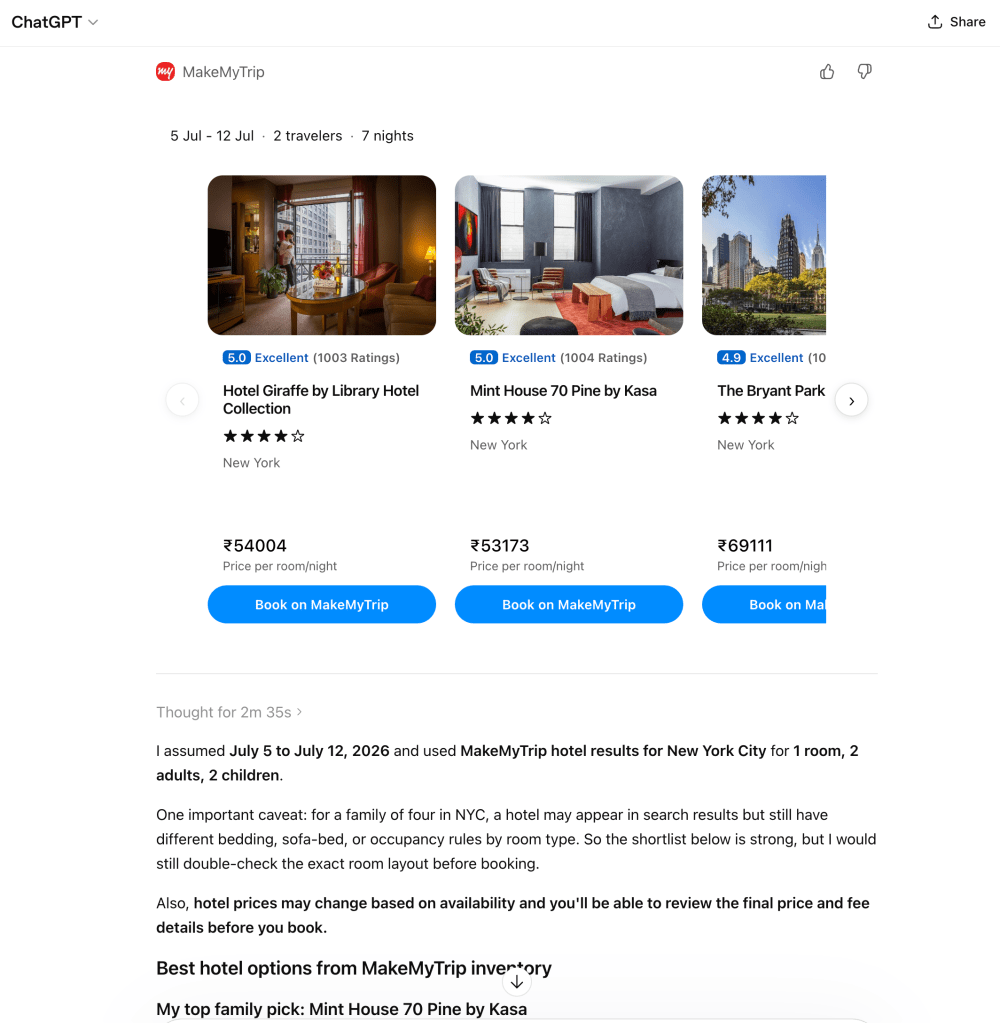
MakeMyTrip also defaulted to showing prices in Indian Rupees despite me searching for hotels in New York City. A small thing, but it signals that the app’s regional wiring doesn’t adapt to the user’s current location or destination being searched.
There’s also the question of economics worth knowing about. Booking.com’s results included affiliate tracking IDs in the URLs, which likely means someone earns a commission when you click through. Whether that’s OpenAI at the moment or simply an easier way to stand up the digital experience using Booking.com’s white label affiliate program isn’t clear, and I don’t want to imply anything sinister. But it’s worth noting that not all app integrations may be commercially identical.
The Multi-App Moment
Almost by accident, I stumbled onto the most promising use case. I asked ChatGPT to check Hyatt, ALL Accor, and Booking.com simultaneously in one conversation, using the @ mention for each app.


It worked. Three different inventory sources, queried in parallel, with ChatGPT synthesising across all of them to recommend a single best option (The Michelangelo via Booking.com at $2,741 for the week, beating the chain options on value).
This is something you genuinely can’t do on any single hotel website or OTA today. A meta-search concierge that pulls from multiple sources and applies a consistent decision framework across them, in natural language, in one conversation.
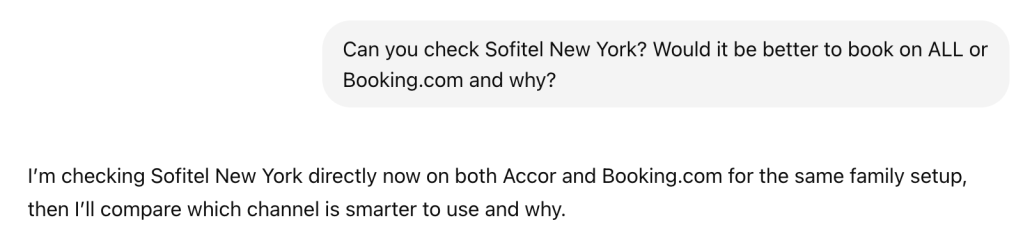
But it also exposed cracks in the plumbing. When I asked ChatGPT to compare the Sofitel’s price on ALL versus Booking.com, it couldn’t do it cleanly. The ALL Accor app returned a visual map widget showing the price on screen, but didn’t feed the number back into the chat as structured data ChatGPT could reason over. Booking.com returned clean numbers. So the comparison was lopsided through no fault of ChatGPT’s.
The promise of multi-source comparison is real. The data consistency across apps isn’t there yet.
What Would Make This Actually Good
I want to be fair. These apps launched as connectors in late 2025 and the ecosystem is evolving fast. What I’ve tested at the end of March 2026 may look very different by the end of the year. The bones are there. Live inventory in a conversational interface is genuinely useful. Multi-app querying is a glimpse of something with real potential.
But for this to become the travel concierge we actually want, three things need to happen. Account connection, so the AI can see my loyalty status, my member rates, my preferences, and my booking history. Transparent sourcing, so every response clearly shows what came from live data versus the AI’s own knowledge. And consistent data feeds, so when ChatGPT compares prices across apps, every app returns numbers it can actually work with, not just visual widgets that look nice on screen but are invisible to the AI’s reasoning engine.
None of these are technically impossible. They’re just not here yet.
What I’ll Actually Do on My Next Trip
So would I use ChatGPT’s travel apps to plan my next hotel stay?
Honestly? Not yet. Not as they are today.
Here’s why. The apps remove two things I actually value: live web search (which gets switched off when an app is connected) and the ability to steer ChatGPT towards its most capable thinking model. When I’m planning a real trip with real money on the line, I want ChatGPT working with the freshest possible data and its sharpest reasoning, not constrained by a single app’s inventory feed.
What I will keep doing is using ChatGPT’s native capabilities. For our recent family trips, I’ve been using ChatGPT Projects, which has been an absolute game changer. I create a project for each major trip, load it with the right context (dates, preferences, budget, loyalty memberships, specific requirements), and then run multiple chats within that project. One for initial hotel research with web search enabled. Another for itinerary planning. Another for restaurant scouting. Each chat can reference the project’s context without me repeating myself, and the whole thing stays organised in one place.
For our last family trip, which was a fairly complex one, the project ended up with about 30 to 40 conversation threads. Early on it was all about planning: researching hotels, comparing options, mapping out the broad itinerary. Then as the trip got closer, it shifted to creating detailed logistical itineraries for each day, usually the evening before. And during the trip itself, I used it for live advice: pivoting plans when something wasn’t working, finding alternatives on the spot, going deeper on things we discovered along the way. That’s a level of continuity and context these apps simply can’t offer yet.
But I’ll be watching these apps closely as they evolve. The moment they can connect to my actual loyalty accounts, surface member rates and redemption options, and work alongside ChatGPT’s web search rather than replacing it? That changes the equation entirely. I’ll be first in line to test that version.
What This Means for Hotels
For my fellow hotel industry professionals, here’s the takeaway that matters most.
Your guests are going to start arriving at your website via an AI recommendation rather than a Google search. It’s a trickle at the moment, but some already are. The question isn’t whether to build a ChatGPT app. It’s whether the app you build actually gives the AI enough about your property, your rates, and your guest’s relationship with your brand to recommend you over the competitor down the street.
This is also where the conversation about AEO and GEO (Answer Engine Optimisation and Generative Engine Optimisation) gets real. You’ll hear a lot of people talking about this right now, and I’ll be honest: most of what I’m seeing is just good old SEO with a bit of AI varnish on top. That’s not enough.
What actually matters is this. AI models like ChatGPT are increasingly where your potential guests start their research. Google’s AI Overviews are appearing in a growing share of search results. Perplexity, Gemini, and Claude are all being used to plan trips. If your hotel’s content doesn’t directly answer the kinds of questions people are asking these tools (“best family-friendly hotel near Central Park with two queen beds and breakfast included”), you’re less likely to show up in the response. My own test proved this: The Wallace kept appearing as ChatGPT’s favourite, which tells you something about how that property’s information lives in the training data.
The practical advice? Structure your property descriptions and website content around real guest questions, not marketing copy. Make sure your room types, amenities, policies, and differentiators are clearly stated in formats that AI can parse and cite. Maintain consistent, accurate information across every platform where your hotel appears, because that’s what feeds the training data. And invest in genuine, detailed guest-facing content rather than generic descriptions that could apply to any hotel in any city. This goes deeper than tweaking meta tags. It means rethinking how your property tells its story in a world where the first reader might be an algorithm, not a human.
Because right now, ChatGPT is making recommendations about your hotel with or without your help. And it already has favourites.
Discover more from Hotelemarketer by Jitendra Jain (JJ)
Subscribe to get the latest posts sent to your email.
 Hotelemarketer by Jitendra Jain (JJ)
0 comments on “I Tested Every ChatGPT Travel App So You Don’t Have To. Here’s What Hoteliers Need to Know.”