
Every now and then, you stumble across a fact so strange, so brain-warping, it makes you question whether you’ve misunderstood reality this whole time.
If you’re in the mood to have your mind gently melted, here are some utterly true facts that will flip your understanding of the universe upside down, without even finishing your coffee.
Science So Weird, It Sounds Made Up
Spoiler: Everything’s Weirder Than You Think
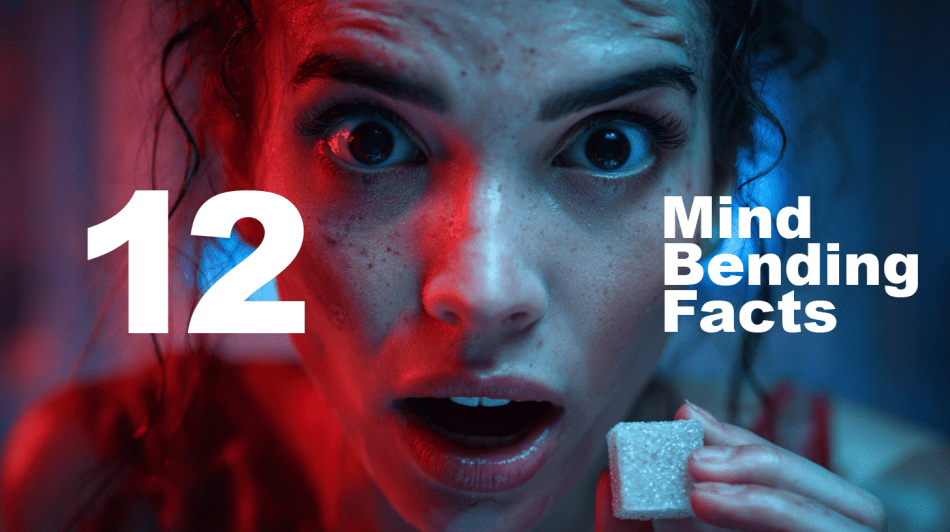
🥄 A sugar cube containing… everyone
Humans feel solid, but mostly we’re empty space. Squeeze out all that emptiness from every person on Earth, and you’d be left with just one tiny sugar cube. Heavy breakfast indeed.

The science: Strip the 99.999 999 % empty space from our atoms and you’re left with ~5 × 10¹¹ kg of nuclei packed at ~3 × 10¹⁷ kg m⁻³ → 1.6 mL, the size of a sugar cube.
🍌 The antimatter banana
Your innocent banana is quietly producing antimatter – yes, antimatter – roughly once an hour, thanks to its radioactive potassium. The good news: your fruit bowl won’t explode (today).

The science: A banana’s potassium-40 emits a positron roughly every 75 minutes – tiny, harmless, but bona-fide antimatter created on your kitchen counter
☀️ The Sun’s painfully slow exit
Sunlight takes only 8 minutes to reach Earth, but before that quick dash, the photons spend around 170,000 years zigzagging through the Sun’s dense core. Imagine taking almost forever just to get out the door.

The science: The Sun is a very lazy lamp: a photon born in its core needs ~170 000 years of pin-balling before it reaches the surface – then only 8 minutes to hit your skin. Yet every second that same Sun annihilates ~4 million tons of itself into pure energy.
📍 GPS: Einstein’s daily cameo
GPS satellites’ clocks run 38 microseconds fast per day due to Einstein’s theories. Without adjusting, your phone would soon insist you’re across town – or worse, visiting an Ikea on a Sunday afternoon.

The science: GPS works only because its satellites “time-travel” 38 microseconds into the future every day. Special relativity makes orbiting clocks slower by 7 µs d⁻¹, general relativity makes them faster by 45 µs d⁻¹; net +38 µs must be pre-corrected or your phone would drift kilometres daily.
📄 Fold to the Moon (no scissors needed)
Fold a single piece of paper 42 times and you’d reach the Moon. This is how exponential growth quietly mocks your intuition and laughs gently at your stationery drawer.

The science: Fold an ordinary 0.1 mm sheet of paper 42 times and its thickness would span the Earth–Moon gap (~440 000 km). Each fold doubles thickness: 0.1 mm × 2⁴² ≈ 4.4 × 10⁸ m. Exponential growth bites hard.
🥇 Alien bling
Gold doesn’t come from Earth’s crust – it formed billions of years ago during dramatic cosmic smash-ups between neutron stars, then crash-landed here on meteorites. Your wedding ring? Literally extraterrestrial debris.

The science: Gold is literally alien. Every atom of gold in your wedding ring was forged in cataclysmic neutron-star mergers (and probably some magnetar flares) billions of years before Earth formed, then rained down in meteorites onto the young planet. Also, all the gold ever mined in human history would fit into a single 22-metre cube (about 3.5 Olympic swimming pools).
🌌 Stars > Sand
There are more stars in the observable universe than grains of sand on all of Earth’s beaches combined. If that makes you feel small, remember: you’re technically made of stardust, so call it even.

The science: Rough census: ~10²⁴ stars vs. ~7 × 10¹⁸ grains of beach sand – a hundred-thousand to one margin.
🧬 The Pluto Roadtrip (in your cells)
Stretch out all the DNA from your body’s trillions of cells, and you could take a leisurely drive to Pluto and back… 17 times. And still have enough mileage left to pop by the Moon for ice cream.

The science: Uncoil the ~2 m of DNA in each of ~37 trillion cells and you get ~74 billion km of molecule.
👻 Neutrinos: The polite ghost particles
Every second, around 100 trillion neutrinos from the Sun breeze straight through you – without stopping, asking permission, or buying anything from duty-free. You’re essentially invisible to most of the universe’s traffic.

The science: 100 trillion ghost-particles fly through you every second. Neutrinos from the Sun (and cosmic rays) ignore almost all matter – including you – thanks to feeble weak-force interactions.
⏰ Earth’s billion-year wake-up call
The Sun isn’t rising, it’s slowly turning up the heat. Literally.
It gets about 1% brighter every 100 million years, which doesn’t sound like much… until you realise that in 1 to 1.5 billion years, Earth will be so hot that our oceans will start to boil away. That’s the beginning of the end for complex life.
But here’s the twist: we went from single-celled blobs to brainy apes with Wi-Fi and TikTok in just half a billion years. That means we’ve already pulled off one evolutionary miracle – on a shorter timeline than what’s still available.
So whether we go biological, cyborg, or full upload-to-the-cloud, the next billion years offer a lot of runway.

The science: Solar luminosity creeps up ~1 % every 100 M yr. Climate models converge on a “moist-greenhouse” limit 1–1.5 billion years from now, after which oceans boil away.
💨 You’re a microbial Caesar-breathing remix
Take a deep breath. Statistically, there’s a good chance you’re inhaling a molecule from Julius Caesar’s last exhale – still drifting through the atmosphere, two millennia later. That’s how thoroughly air mixes.
Now consider this: your own body is a co-op. For every human cell, there’s roughly one bacterial cell tagging along for the ride. You’re less a lone individual and more a walking ecosystem – part Roman history, part microbial party bus.
You’re basically a cloud of ancient air wrapped in a bacteria-forward body, somehow managing to check emails and complain about airline food.

The science: Odds are your next breath contains at least one molecule exhaled in Julius Caesar’s dying gasp. His final 25 sextillion molecules have had two millennia to diffuse; statistical mixing puts ~1 of them in every litre of modern air you breathe. Also, your body is basically half human, half microbe by cell count. Revised 2016 estimates: ~3 × 10¹³ human cells vs. ~3.8 × 10¹³ bacterial cells – a near 1:1 ratio, not the old 10:1 myth.
👽 The Aliens Are (Probably) Us
We’ve scanned the skies, listened for signals, and searched for Dyson Spheres – and yet, the galaxy is suspiciously quiet. That’s the Fermi Paradox: if the universe is teeming with intelligent life, where is everybody?
But here’s the weird part: given the vast distances between stars and the short shelf life of most civilizations (nukes, anyone?), it’s statistically more likely that the first intelligent life we meet won’t be aliens… it’ll be our own descendants.
If we make it past our current existential speed bumps, future humans -biological, cyborg, or fully digital – could spread across the stars. They might return one day, curious about their origins, poking through Earth’s ruins like tourists at a museum. So yes, that UFO might be a post-human grad student on a thesis trip. Hope we make a good impression.

The science: Interstellar travel is staggeringly difficult and slow. If intelligent life is rare and short-lived, the most probable long-term presence in our galactic neighbourhood is ourselves – if we survive long enough to leave a trace.
Congratulations, You’re Officially a Cosmic Oddity
So what do a sugar cube, a banana, and a time-traveling satellite have in common? They’re all hiding truths that are so wild, they sound made up – until the math proves otherwise.
The universe isn’t just weirder than we imagine – it’s weirder than we can imagine.
And once you realize that every breath you take might include Julius Caesar’s dying gasp, and the next alien visitor might just be your great-great-grand-cyborg-nephew, it gets a little harder to take “reality” too seriously.
Pass the antimatter fruit bowl, and enjoy the ride.
Discover more from Hotelemarketer by Jitendra Jain (JJ)
Subscribe to get the latest posts sent to your email.
 Hotelemarketer by Jitendra Jain (JJ)
Curious, what model did you use for image generation on this one?
LikeLike
This was all Midjourney
LikeLike