
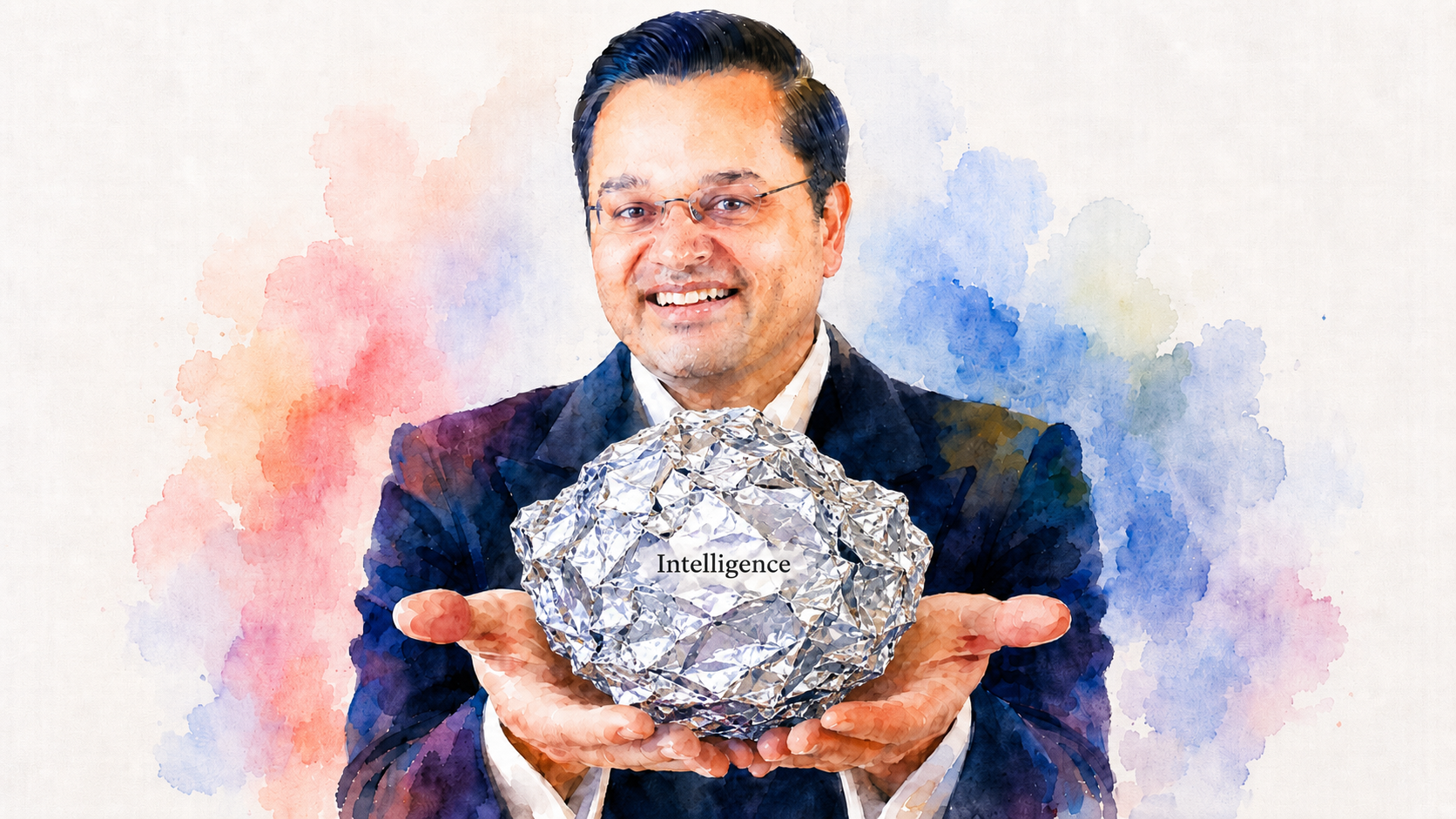
Picture this. It’s the mid-1800s and America wants to build a monument to its first president that towers above every other building on Earth. 555 feet of marble, granite and engineering bravado, designed to be the tallest structure in the world.
We needed something to cap it. The most precious metal we could think of. We chose 100 ounces of aluminum.
Yes, aluminum. The same metal that wraps your sandwich.
At the time, aluminum was rarer than gold. Difficult to extract. Stunning to look at. Tiffany’s put a piece on display in their Manhattan window before it shipped to Washington, because that’s what you do with treasure.

Then a young inventor figured out electrolysis. The trick of separating aluminum from ordinary dirt. Within decades, the most precious metal in the world was a throwaway material. We wrapped our chocolates in it. We crumpled it up and tossed it in the trash.
This is the story Sequoia partner Konstantine Buhler told at AI Ascent 2026, a closed-door gathering of around 150 of the world’s most consequential AI founders and researchers. And then he delivered the line I haven’t been able to shake since.
Aluminum is intelligence. Electrolysis is artificial intelligence.
We are about to enter a world where some of the most precious skills humans have ever developed, the kind that took decades of training and tens of thousands of dollars in tuition, will be invoked instantly, used once, and crumpled up.
Welcome to the Aluminum Era. Whatever your industry is, you are downstream of it.
The cars have arrived
Sequoia’s Pat Grady opened the day with a line so good I keep stealing it.
For most of the last decade, the new technology cycle gave us faster horses. Software that made you 10 to 40 percent more productive. Useful. Incremental. Comfortable.
What we have now are cars. Software that makes you 10 to 40 times more productive and changes the shape of your work entirely. The way you ride a horse and the way you drive a car aren’t the same activity. Same here.

The evidence stacks up fast. (The geek in me leans excited. The hotelier in me is taking notes.)
Anthropic’s Boris Cherny, the engineer who built Claude Code (the AI tool now writing most of the world’s frontier software), runs his entire workday from his phone. He hit 150 pull requests in a single day as a personal record. (A pull request is roughly one complete, ready-to-ship piece of finished software. 150 of those in a day is comically, almost suspiciously productive.) Every person on his team writes code, including the legal lead and the user researcher.
OpenAI’s Greg Brockman, the co-founder and President of the company that gave us ChatGPT, tells the story of one of his engineers who handed an AI a complicated systems problem, went to sleep, and woke up to find the model had implemented the spec, profiled it, found the bottleneck, and iterated until it was fast. The plan was to give it to the team for a week of work. It was done overnight.
The team at Notion (the workplace docs tool used by millions of companies) rewrote 8 million lines of their codebase in six weeks. Brett Taylor, the former Salesforce co-CEO who now runs the AI customer-service company Sierra, rebuilt the entire Sierra product over a weekend with his co-founder.
Andrej Karpathy, a co-founder of OpenAI, the man who built Tesla’s Autopilot AI, and one of the most respected explainers in the field, said something at the conference that should make every professional pause. He said he’s never felt more behind as a programmer. He coined the term “vibe coding” last year, which is the practice of describing what you want in plain English and letting the AI write the actual code without checking it line by line. And even he can’t keep up with the field he helped create.
Plus there’s voice. ElevenLabs has voice agents that can match your emotion. If you’re stressed, they slow down and reassure you. If you’re excited, they match you. They are already deployed in customer support, government services, and inbound sales. The Ukrainian government built a voice agent so citizens can call in and get information from their state when the war makes the app inaccessible.
There’s autonomy. Waymo went from 8 years to launch in 4 cities to launching in 4 new cities on a single day. They’ve now done over 20 million fully autonomous rides. Their driver is 13 times safer than a human, preventing one serious-injury crash every eight days at current scale.
There’s even security. An AI bot called XBOW became the number one hacker in the world on HackerOne, finding software vulnerabilities completely autonomously. It found a remote-code-execution flaw in Bing at a total cost of about $3,000 to run. The lag between a vulnerability being publicly disclosed and being exploited used to be two and a half years. Today it’s gone negative. Bad actors are exploiting things before they get reported.
If those numbers don’t make you blink, read them again.
This is what a $10 trillion services market beginning to be eaten by software actually looks like. Software was a $650 billion business at its peak. Legal services in the United States alone is $400 billion. There are dozens of verticals like that. Every one of them is in play.
The risk worth actually worrying about
OK. So if everything is up for grabs, what should hospitality people be doing?
The lazy answer is “throw AI at every problem.” I see versions of this every week on LinkedIn. Hotels announcing AI concierges that are mostly chatbots with a fresh coat of paint. Vendors selling SEO with a bit of generative varnish. AEO this, GEO that.
I worry about that response more than I worry about doing nothing. Doing nothing at least leaves you with your strengths. Throwing AI at a broken process is, as I sometimes describe it, putting a bandaid on a broken leg. It doesn’t fix the leg. It just looks busy.

The real risk for hospitality isn’t that we move too slowly into AI. It’s that we move too quickly in the wrong direction. We industrialise the parts of our business that should stay artisan, and we ignore the parts that are about to need a complete redesign.
I am implicated here, by the way. I’ve sat through plenty of meetings where I’ve nodded along to roadmaps that solve last year’s problems. Most of us have. Plus there’s the inertia we don’t always talk about. Legacy tech debt that takes years to unwind. Annual budget cycles that lock decisions in twelve months at a time, when the actual technology cycle is now measured in weeks. The system itself is wired against the kind of pace this moment demands. The trick is to notice when the entire shape of the conversation needs to change, and then to find ways to change it that the organisation can actually absorb.
What stays scarce when expertise gets cheap
Here’s the part of Konstantine’s talk that doesn’t get quoted enough.
He pointed out that for tens of thousands of years, the entire history of art was a march toward realism. Cave paintings, hieroglyphs, Greek pottery, Renaissance masterpieces. Every generation of artists tried to capture the moment exactly as the eye sees it.
Then photography arrived. In a single human lifetime, the skill of perfectly rendering reality became obsolete. The machine could do it better than any human, every time, in a fraction of a second.
People thought painting was finished. It wasn’t. What followed was Impressionism, Expressionism, Cubism, abstract art. All of the most extraordinary visual creativity of the modern era happened because the machines took over the literal job. Humans moved up the stack to the things only humans could do. Capturing the moment as the heart and soul see it, rather than the eye.

There is a hospitality lesson sitting right there.
When expertise becomes aluminum, the remaining premium goes to the things expertise cannot replicate. The look across a room that says I see you. The bartender who remembers your usual without checking the system. The general manager who comes out from the back office because someone is having a hard day. The room set up exactly the way you didn’t know you needed.
Konstantine closed his keynote with this line.
AI can do the work. AI will do the work. But only the human connection can give you a reason to care.
We are in the original “you had to be there” business. Hospitality has been quietly preparing for this moment for two thousand years.
What you might actually do this Saturday
Three things, none of them requiring you to be technical.
One. Ask yourself which parts of your operation are about expertise (which is becoming aluminum) and which are about presence (which isn’t). Get ruthless. Most of us have spent the last decade automating the wrong things and protecting the wrong jobs.
Two. Take one hour and use a frontier AI model the way Boris Cherny uses it. Don’t just type a question. Give it the full context of a real problem, ask it to plan, then come back to it after a coffee. The shift is shocking. (If you finish the hour and shrug, you’re using it wrong. Try again with a harder problem.)
Three. Pick one human moment in your guest experience and over-engineer it on purpose. Not the booking flow. Not the check-in form. The arrival. The first real conversation. The recovery from a bad moment. The send-off. Whatever your equivalent of an Impressionist painting is, that’s where the next decade of competitive advantage will live.

Hospitality is not in trouble. The version of hospitality that thinks it can survive on operational excellence alone is in trouble. There is a meaningful difference between those two sentences.
Back to the monument
We capped the Washington Monument with aluminum because, at that moment, aluminum was the most precious thing humans knew how to make.
The monument is still there. The aluminum is still on top. What makes it valuable now isn’t the metal. It’s the meaning. The pilgrimage. The people standing at its base, looking up.
In a world of disposable expertise, the buildings worth gathering at will be the ones that make people feel something only people can make them feel.
The aluminum will get cheap. The meaning never will. Build for the meaning.
Where this came from
For anyone unfamiliar, Sequoia Capital is the venture firm that, since 1972, has backed Apple, Google, Stripe, Airbnb, WhatsApp, Nvidia, Instagram and dozens of other companies you’ve heard of. They host AI Ascent once a year as a closed-door gathering of the people actively building the AI frontier. This year’s edition (April 2026) included Demis Hassabis of Google DeepMind, Greg Brockman of OpenAI, Andrej Karpathy, Jim Fan of Nvidia, Dmitri Dolgov of Waymo, Boris Cherny of Anthropic, Mati Staniszewski of ElevenLabs, and many more.
I watched all thirteen of the talks they made public. The aluminum story above is from the opening keynote. If you want to go deeper, the full playlist is here:
A few hours of your weekend, well spent.
Discover more from Hotelemarketer by Jitendra Jain (JJ)
Subscribe to get the latest posts sent to your email.
0 comments on “Aluminum Was Once More Precious Than Gold. Now It Wraps Your Sandwich. Your Industry Is Next.”