
What a non-coder actually built with ChatGPT Work, Claude Code and Cowork, on a couple of ordinary Saturdays.
I can’t write a single line of code.
Not one. No Python, no JavaScript, no clever little scripts. Hand me a terminal and ask me to fix a stray comma, and I’ll hand it straight back to you.
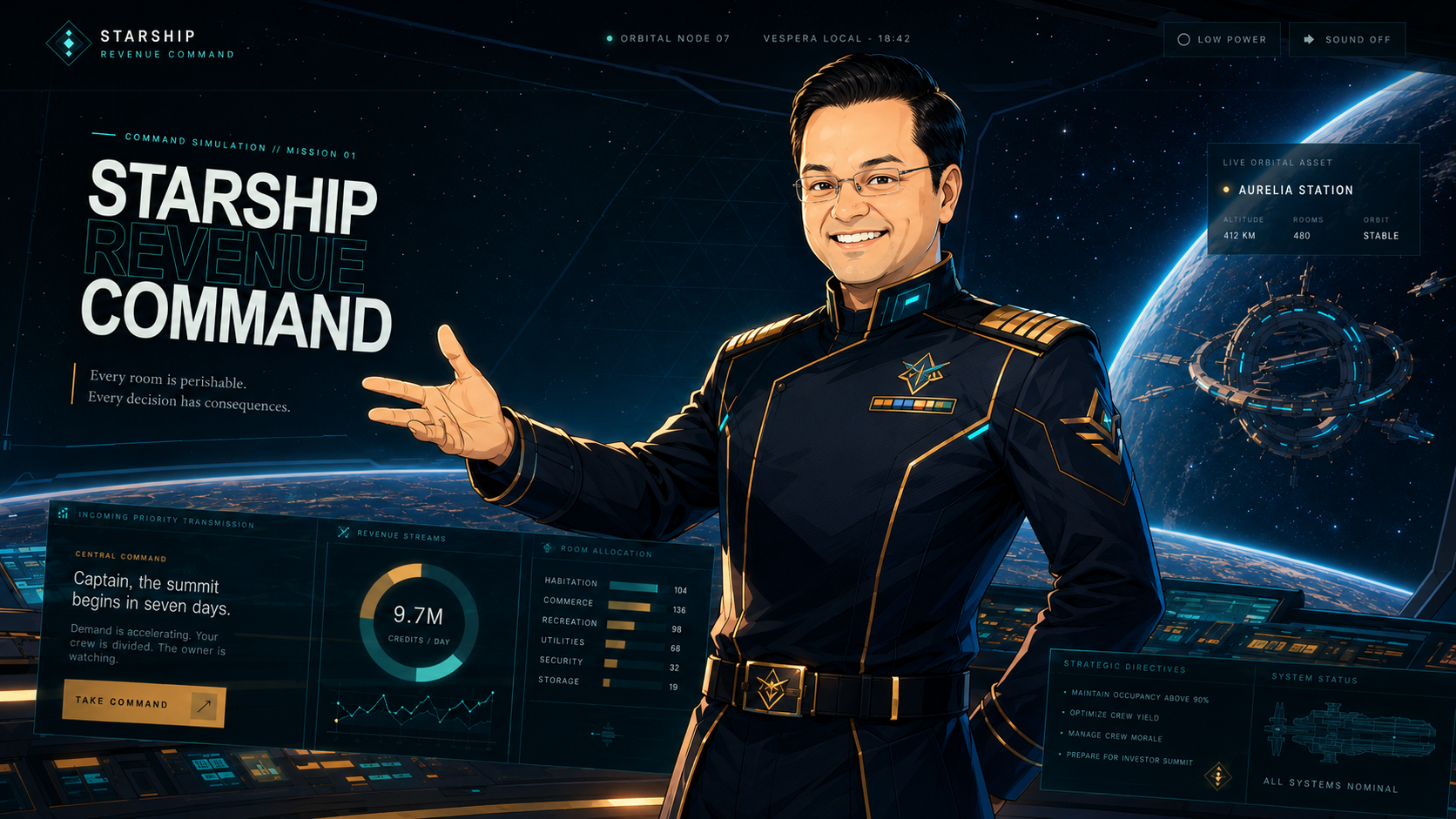
And yet, over two ordinary Saturdays, I built two things I’d have called impossible not long ago. One is a space-themed hotel revenue game that looks like it wandered out of a studio. The other is a private health dashboard that pulls live data off my Oura ring and helps me hunt down the cause of my morning headaches.
Same non-coder. Two very different builds. One quiet, slightly unsettling conclusion: the distance between “I wish this existed” and “this exists” has almost disappeared.
Let me show you both. The gap between how they came together is the actual story.
Build one: the game that took one prompt
I’ve spent over 25 years in hotels, mostly around the commercial edges: digital, distribution, loyalty, partnerships, marketing. Revenue itself only became my day job at the start of last year, and broader commercial performance this year. Perishable rooms, displacement, compression, the eternal temptation to just slash rates and pray. It’s genuinely hard to explain to people why these decisions keep senior commercial teams awake at night.
So I asked myself a daft question: could I turn all of it into a game?
One thoughtful prompt. That’s what I gave ChatGPT Work (running the new 5.6 Sol Max) and Claude Code (Opus 5 High). I described a premium, browser-based strategy game where you captain a luxury orbital hotel above a strategically important planet, seven days before a major interplanetary summit. Five decisions. A crew with strong, conflicting opinions. Every choice nudging occupancy, rate, profit, owner confidence and guest trust all at once, exactly like real life.

Under an hour later, I had Starship Revenue Command. A slowly rotating planet through the viewport. A command crew who actually argue with each other. A tempting red “Emergency Discount Protocol” button that, much like in the real world, usually makes everything worse. And at the end, a shareable captain profile telling you whether you’re a Precision Strategist or, heaven forbid, got Assimilated by the OTAs.

I’ll be honest about what this is. It was one prompt, and it’s a foundation, not a finished masterpiece. I could build plenty more on top of it, though I haven’t decided whether I will. But the fact that “pretty decent, genuinely playable, quietly teaches a real skill” now arrives in under an hour, from a single paragraph, still makes me sit back in my chair.
Build two: the dashboard that took patience

The health dashboard was a completely different animal.
I occasionally wake up with a headache and I’ve never quite been able to pin down why. My hunch is something as mundane as how my neck sits overnight. I actually started wearing an Oura ring a couple of years ago for a different reason, to keep an eye on sleep quality and oxygen levels, and it quietly collects far more than the app ever chooses to show me. Plenty of data, none of it pointed at the question I actually wanted to ask.
So I built my own. A private workspace with a morning check-in, a live feed from the Oura API, and a “Headache Lab” that compares my headache mornings against my own non-headache baseline. Associations, not causes. Slowly triangulating, over time, what might really be going on.

Here’s the part I want you to hear clearly: this one did not arrive in an hour.
The core came together on a Saturday, just like the game. Then came the patience. Most of the wrestling was getting the data to download reliably from the API. Things that half-worked. Things that broke. Long stretches of me describing the problem in plain English, watching it get fixed, finding the next snag, and describing that one too.
I never once opened a coding manual. I just stayed patient and kept talking to the machine like a colleague who’s brilliant, tireless, and occasionally needs three goes to get it right.
The contrast is the lesson
Two builds. One took a single prompt and an hour. The other took a full Saturday and a lot of stubborn back-and-forth. Both came from someone who cannot code.
That contrast is the whole point.
We’ve spent two years arguing about whether AI is magic or hype. The honest answer, from someone who just lived both versions inside a fortnight, is that sometimes it’s genuinely instant magic, and sometimes it’s patient, unglamorous iteration. Neither one asks you to be technical anymore. Both ask you to know what you want, and to be willing to stay in the room until you get it.
What carried both builds wasn’t clever code. It was patience. Call it the Patience Premium: in a world where anyone can describe software into existence, the edge belongs to the people who don’t give up on the third broken attempt.
What this actually means for you
I’m not telling you to go build a game or a health lab. I’m telling you that the thing you’ve been quietly wishing existed, the little tool that would make your work or your week noticeably easier, is now probably within reach of a few good sentences and an afternoon of patience.
You don’t need permission. You don’t need a developer on standby. You don’t need to “learn to code first.”
You need an idea, a clear description of it, and the willingness to keep going when version one isn’t right.
I built two of these in the gaps between everything else, knowing zero code, mostly on Saturdays. If a hotel guy who hands the terminal straight back can manage that, I promise the gap is smaller than you think.
So pick the one thing you keep wishing existed. Describe it to an AI this week. Then stay in the room until it’s real.
I still can’t write a single line of code. Turns out I didn’t need to. And neither, I suspect, do you.
Discover more from Hotelemarketer by Jitendra Jain (JJ)
Subscribe to get the latest posts sent to your email.
0 comments on “I Can’t Write a Line of Code. I Built Two Working Apps Anyway.”