

A candid interview with Nitin Thariyan on getting real value from the AI hotels already own: what works, what breaks, and where to start.
Picture your best salesperson spending three hours building a proposal a machine could draft in five minutes. Now picture what they’d do with the other two hours and fifty-five.
That gap, between the work our people do and the work only people should do, is the whole conversation about AI in hotels. Not the robots. The reclaiming of time.
I’ve known Nitin Thariyan since our Starwood days, when the two of us sat on a small but mighty regional team in the Middle East. He’s since founded Lean On Data and co-founded Deep Hospitality, and he belongs to a rare category: people who don’t just advise on AI but build and run it themselves, every day, right down to agents they message like colleagues.
I sent him a dozen questions. What came back isn’t hype. It’s an honest, occasionally funny look at what works, what breaks, and where to begin. Lightly edited, in his own words, here’s Nitin.
1. The making of you.
Before we dig in, give readers the two or three moments, Jumeirah, Starwood/Marriott, then striking out on your own, that shaped how you think about AI in hotels today. What did each one teach you that you still lean on?
I have spent my whole career in hospitality. I did hotel school in Bangalore, started as a trainee chef and then moved through kitchen and food-and-beverage operations at the Oberoi and the Taj back home in India. That beginning still shapes how I look at technology today. I am always asking a fairly basic question: does this actually make the work better for the person doing it, or are we simply adding another layer?
The first major chapter for me was Jumeirah. I joined Jumeirah Beach Hotel in 1999, when the company was expanding rapidly. It was a beautiful time to be there, and I was fortunate to work for a genuinely progressive organisation. Jumeirah invested enormously in me. They sponsored my master’s education, sent me to the US and the UK, supported my PMI conferences, and gave me access to Lean Six Sigma through Motorola University. I received far more from Jumeirah than I ever gave back, and I remain truly grateful for that.
Those years also taught me to see a hotel as a complete system. We were standardising through ISO, learning from the EFQM business-excellence model through Dubai Holding, working with Balanced Scorecards and thinking about lead and lag indicators. We were exposed to Stephen Covey and to leaders who took development seriously. It was not just about guest satisfaction or profit in isolation. It was about how leadership, people, processes, customers and results all connect. That systems view has stayed with me.
The second major chapter came in 2015, when Starwood selected me to lead operational innovation for the Middle East. I joined a small, tightly knit team, reporting to Guido, where every person was an expert in their own right. I often say I was standing on the shoulders of giants and enjoying the reflected glory of a remarkable group – which included you, JJ. Starwood taught me how powerful a small, trusted team can be when it is given permission to challenge the way work gets done.
After the merger, I continued with Marriott and was again fortunate to keep learning. I attended the Ascent programme in the US and worked on analytics, data science and large-scale human-resources transformation. In hotels, one of the largest lines on the P&L is people cost, but it is never simply about cutting people. It is about productivity, deployment and making sure employees are able to serve guests well. That is the service-profit chain in practice: look after the people, help them do good work, and the guest outcome tends to follow.

The third chapter was stepping out on my own. After many years in large organisations, I founded Lean On Data, which felt like the natural next step. It gave me the opportunity to take everything I had learnt over the previous two decades and apply it across different hospitality companies, rather than within just one. It also forced me to stop talking about transformation in theory and start building solutions that had to work in the real world.
More recently, together with my good friend and former colleague Caroline Hardman, we co-founded Deep Hospitality. The idea came from a simple belief: hospitality does not need more generic AI. It needs AI that genuinely understands how hotels operate, how guests behave, how teams work and how owners measure success. We built Deep Hospitality around that philosophy, combining decades of operational experience with modern AI to help leadership teams eliminate friction, return time to their people and build lasting capability. Readers can find us at www.deep-hospitality.com.
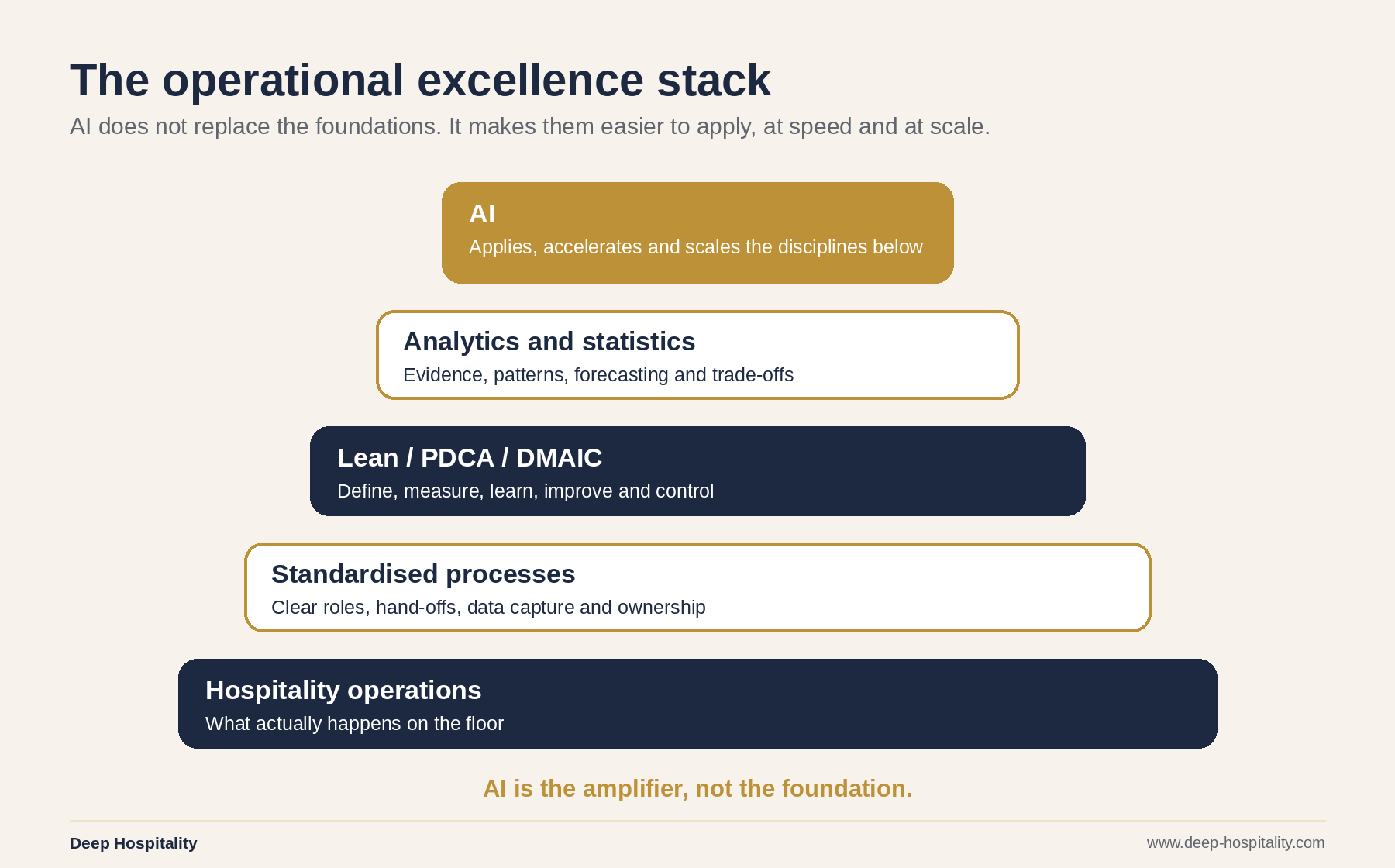
That is where AI became particularly fascinating to me. It brought together everything I had learnt throughout my career – operations, Lean Six Sigma, business excellence, statistics, analytics and change management – and suddenly made many of those disciplines far more accessible to everyday hotel teams.
I do not see AI as replacing those foundations. Quite the opposite. The principles behind operational excellence, PDCA, DMAIC and process improvement have stood the test of time. AI is simply the catalyst that allows those timeless disciplines to be applied faster, at greater scale and by many more people than was ever possible before.
AI is not a replacement for the foundations.
It is the catalyst that can finally bring them to life at speed.
2. My hunch, tell me I’m wrong.
Here’s a belief I keep testing: most hotels aren’t behind because they’re missing some cutting-edge AI. They’re behind because they haven’t opened the tools already in front of them, including the enterprise-grade assistant a lot of them already pay for and never touch. Fair? Where do you see the biggest gap between what a hotel could do today with what it already has, and what it actually does?
I think your hunch is right. In many hotels, the biggest opportunity is not a new tool. It is making proper use of the tools already available.
Part of the problem is simply the nature of hotel work. People arrive early, work long hours, deal with live guests and operational issues, and go home tired. There is very little time left to explore a new way of working. We also have a strong perfectionist instinct in hospitality. We do not want to make mistakes in front of a guest or an employee, which is understandable, but that same mindset can create paralysis.
One of the shifts we need is to move from treating everything as a project to treating more things as controlled experiments. I am not suggesting that a hotel should become reckless. I am suggesting that leaders create safe spaces where teams can test, learn and improve without every attempt having to be perfect on day one. That requires tolerance from the top. Speed and perfection do not always sit comfortably together.
The tool is only one part of the equation. Even when organisations provide the latest enterprise AI, many employees struggle to apply it because nobody has shown them how to think with it. Giving someone a licence and saying, “Go and explore,” is not a strategy. They need relevant hotel use cases, realistic data, clear boundaries and some inspiration.
This is where I find AI exciting in relation to Lean and Six Sigma. For years, Yellow Belt and Green Belt programmes taught excellent methods, but many people found them too academic or difficult to apply after the training. The methods themselves remain sound: define the problem, measure it, analyse it properly, improve it and control the outcome. That goes back to Plan-Do-Check-Act. AI now makes those methods easier to use in the flow of work.
So the real gap is not access. It is application. Hotels need to help people identify a genuine problem, frame it properly and experiment with the tools they already have. The question is no longer only, “Which AI should we buy?” It is, “What are we trying to improve, and do our people know how to use AI to get there?”
The real gap is not access. It is application.
3. Show us the delta, not the promise.
One before-and-after where AI moved a real number, RevPAR, labour cost, guest satisfaction, complaint-resolution time, anything. No client names needed. Bonus points if it came from an everyday, approved tool rather than something exotic, because that’s the version most readers can actually copy.
The area I find most interesting is not dramatic headcount reduction. Cutting cost is relatively easy; sometimes you are simply cutting through muscle. The more valuable question is how AI can help a hotel sell more, respond faster and convert more business.
A good example is the enquiry-to-proposal process. Whether it is a banquet enquiry, a corporate room request, a restaurant event, a spa package or a formal RFP, speed matters. Hotels that respond faster generally give themselves a better chance of winning the business. Yet the response process is often slow because somebody has to read the enquiry, find the right information, pull together several internal assets, adapt a template and make the result feel personal.
We have used approved AI tools to turn that into a far quicker and more bespoke workflow. The enquiry is interpreted, the relevant information is brought together, and a first personalised proposal is produced for the salesperson to review. In the right workflow, work that took roughly three or four hours of gathering and assembly can be reduced to four or five minutes for the first draft. The human still reviews the commercial decisions and sends it.
That is not the same as claiming four hours of salary have disappeared. The real value is speed and capacity: responding while the customer is still engaged, handling more opportunities, following up better and putting the salesperson back into the conversation. I would measure median response time, employee preparation time, proposal quality, conversion and the value of business converted.
AI should take away the low-value assembly work – documents, presentations, repetitive formatting and copying between systems – so that the human contribution becomes experience, judgement and context. That is where the value sits.
Saving time is useful. Turning that time into faster responses, better conversations and more revenue is the real delta.
4. Start safe, start now.
A lot of GMs freeze because they’re (rightly) nervous about data and security, so they do nothing. What can a hotel genuinely get done with the sanctioned tools it already has, an enterprise Copilot or equivalent, before it spends a penny on anything new or goes anywhere near guest data it shouldn’t? Where’s the line you’d tell them not to cross on their own?
The concerns are real. Guest PII, employee information, payroll data, contracts and financial data all need proper controls. One of the more worrying behaviours I see is when an organisation issues a strict company line, but employees then go home and paste confidential information into whichever public model they happen to use. Avoiding the subject does not remove the risk; it often pushes the behaviour out of sight.
The better approach is to use sanctioned, enterprise-grade tools responsibly and show people what they can safely do. There is already a great deal of value in summarising approved internal documents, preparing meetings, drafting from non-sensitive information, mapping a process, analysing policies, creating templates and improving the quality of work inside the organisation’s approved environment.
The line I would not cross independently is anything involving guest or employee PII, passport or medical information, payroll, payment credentials, confidential contracts in an unapproved environment, or an AI taking external action without proper authorisation and controls. Once the system is touching sensitive data or acting on behalf of the hotel, IT, legal, information security and the process owner need to be involved.
I sometimes use the analogy of a sculptor. People spend too much time debating the hammer and the chisel – which model is better, which version is newest – and not enough time deciding what they are trying to make. The real question is: what is the outcome, and which unnecessary steps can we remove to make the process simpler and more valuable for the paying customer?
My advice to a GM would be to keep a private list of the ten things that create the most friction in the hotel. Do not start with the technology. Start with the frustration. Ask which one, if improved, would create a disproportionate result. Then use the approved tools you already have to begin testing.

5. No bandaids on broken legs.
We both believe you can’t just throw AI at a mess and hope. Housekeeping not logging preferences, front desk buried in repetitive tasks, data scattered across five systems. What has to be fixed the old-fashioned, low-tech way first, before an AI layer actually pays off?
AI cannot compensate for data that was never captured, a process nobody follows, or five systems that disagree with one another.
Personalisation is a good example. Everyone talks about moving beyond broad personas towards treating each guest as an individual. AI makes that possible at scale, but only if the hotel is actually observing, recording and consolidating useful information.
The data is often already sitting in different places: the point-of-sale system, the restaurant hostess logbook, guest comments, finance systems, front-office notes and employee observations. The problem is that it is fragmented, and not every piece of data has the same reliability. A reconciled transaction is hard evidence. A recorded preference may be useful. An employee observation may be valuable but still needs context. An AI inference is different again.
Before adding an AI layer, I would first agree what information matters, where it should be captured, who owns it, how reliable it is and how it can be used. I would also remove obvious duplication and clarify the process. None of that is glamorous, but it is what makes the AI useful later.
The same applies to any broken workflow. If the front desk is buried in repetitive work, first understand the steps, the hand-offs and the reasons for the repetition. AI can then remove friction, but it should not be used to automate confusion.

6. The buy-in problem.
You’ve said progress usually stalls until the most senior person in the building genuinely believes. What are the real fears owners and GMs voice behind closed doors, and what actually changes their mind, versus what just makes them nod politely?
The biggest concern I hear is very practical: “This is all impressive, but where is the impact on GOP?” Owners and GMs have seen AI make pictures of cute cats, improve emails and produce clever demonstrations. Many have still not seen it change a meaningful business outcome.
There is also an uncomfortable ROI question. If an employee saves two hours, the salary does not automatically disappear. The fixed cost remains. So leaders quite rightly ask whether the hotel has genuinely transformed a workflow or simply made one person a little faster.
Behind closed doors, the other fears are accountability and risk. Who is responsible when the output is wrong? Is confidential data exposed? Is this another corporate initiative that will create licences, training and noise without changing the operation? Those are reasonable questions.
There is a human issue underneath this as well. I have worked on process improvements – with AI and without it – where people realise that a task that gave them status or control can suddenly be done in a fraction of the time. You can see a genuine sense of loss. Sometimes the data goes into a black box, knowledge is protected, or the process becomes mysteriously more complicated. That is rarely because people are difficult. It is because the change feels like a threat to identity and job security.
That is why no AI transformation will succeed if you do not engage the people in the transformation. You cannot design for them. You need to design with them – and, even better, give them the skills and tools to design the solution themselves. A central product can standardise a PMS or a sales platform, but there is a long tail of hundreds of property-level use cases. Those only come to life when the people closest to the work have ownership.
What changes minds is not a polished presentation. It is a real use case, inside their own environment, with a baseline and a measurable result – and with the people doing the work visibly involved. Show that response time fell, conversion improved, a reporting cycle shortened, an error rate dropped or a manager was able to spend more time with guests. Then show the guardrails and who remains accountable.
The goal should be to reduce the back-office burden, protect the necessary controls and put more employee time into guests, decisions and revenue-producing activity. That is when leaders stop nodding politely and start paying attention.
You cannot design AI for people.
You have to design it with them.

7. Help, not replace, and make it land.
How do you make “AI is here to help you, not replace you” feel true rather than like a line, especially with line-level teams in places where job security is a sensitive subject?
I would not pretend AI will affect every job in the same way. It will not. In hospitality, line-level guest-facing roles may use AI less directly than colleagues in finance, HR, sales, marketing or IT, because anything that happens mainly on a computer is likely to be affected sooner and more deeply.
If you are cooking, cleaning a room, serving a table or welcoming a guest, the work still needs hands, judgement, care and human connection. Guests generally want to speak to people, not spend the entire stay dealing with a robot. AI can support those employees, but it does not remove the physical and emotional reality of the work.
The greatest near-term disruption is likely to be in back-of-house and back-office friction: repetitive administration, searching for information, transferring data, checking documents and producing routine reports. That is where AI can reduce cycle time and defects.
To make the message believable, involve employees in choosing the work to remove. Ask them which tasks waste their time, frustrate guests or force them to stay late. Then demonstrate that the technology is taking away that burden, not simply monitoring them or creating a hidden headcount target.

Some of us are old enough to remember the resistance to email. People would say, “Why do I need to email Bob? Bob is sitting right next to me.” It sounded perfectly logical at the time. Today we cannot imagine operating without email. AI is at a similar stage: some people are already using it every day, while others are denying its existence and hoping it will quietly go away. It will take time, but this transition has only just started.
The honest promise is not that every job will remain exactly the same. It is that we should use AI first to make work more human: less administration, fewer avoidable errors and more time for the parts of hospitality that people are uniquely good at.
8. The honest 90-day pilot.
Say a resort GM wants to run one clean 90-day pilot to prove ROI to a skeptical owner. What single workflow would you start with, and which three or four numbers should they watch to know whether it’s working, or whether to kill it without ego?
A very respected VP once told me, “Whatever you do, stay close to the money – stay close to the till.” I would choose one enquiry-to-proposal workflow: perhaps banquet enquiries, corporate room requests or group business. It is contained, measurable, close to revenue and does not require the hotel to begin with the most sensitive guest data.
The pilot would use the hotel’s approved AI environment to read the enquiry, bring together the relevant approved information, prepare a personalised first draft and prompt the salesperson for the missing commercial decisions. A human would still review and send the proposal.
I would track four numbers: median response time, employee preparation time per proposal, conversion rate and the value of business converted. I would also run a simple quality check to make sure speed is not being bought at the expense of accuracy or brand tone.
At the end of 90 days, the decision should be unemotional. If response time has fallen and either conversion or team capacity has improved without creating unacceptable errors, scale it. If the workflow is faster but has no commercial impact, redesign it. If quality or risk is worse, kill it. A pilot is there to learn, not to protect anyone’s favourite idea.

9. Quickfire, a line or two each.
Most over-hyped hotel AI use case right now?
Generic AI-written review responses. Too many hotels are using AI as a grammar cleaner and producing replies that sound mechanical. Without enough hotel context, it removes warmth rather than adding value.
Most underrated one nobody’s talking about?
Forecasting. AI can make established statistical methods – ARIMA, SARIMA, Prophet, regression and others – far more accessible, so hotels can move towards a more scientific basis for forecasting rather than relying only on habit and intuition.
The one tool a skeptical GM should personally test this week?
A paid, enterprise-approved assistant available in the GM’s own organisation. The exact brand matters less than using the full product on one real piece of work rather than judging AI from a restricted free version or a six-month-old experience.
One thing hotels should stop doing in the name of “AI”?
Stop issuing licences without structured training and real hospitality use cases. A blank chat box is not an adoption plan. And stop treating AI as an IT or intern’s job: the best users are often the most experienced people, because they know what good looks like. Plain English is increasingly becoming a programming language.
10. You actually build this stuff.
Something I admire: you don’t just advise on AI, you build and live with it every day, right down to agents you message like a colleague. What has actually building and running these things taught you that you’d never have picked up from a slide deck or a vendor demo? And if there’s one you can show rather than describe, send it over.
I have always enjoyed building things. I tinker with Arduino, Raspberry Pi, miniature robotics and whatever else catches my attention. More recently, that instinct has moved into agents that help me with work I find repetitive.
I currently use an accountant bot, a sales bot and a chief-of-staff bot that helps monitor and classify email and keeps certain tasks moving. I built them because time is the one resource I cannot replace. If a task can be safely delegated to a bot, I would rather do that and spend my attention on judgement, relationships and creating new work.
Building and living with these agents has taught me that the impressive demo is the easy part. Reliability is the hard part.
That was a scary and useful lesson. AI can be confident, tidy and completely wrong for the purpose. During the early stages of any deployment, you have to inspect its work, test edge cases and tighten the instructions and guardrails. Human-in-the-loop is not a slogan; it is how you learn what the system actually does.
Another lesson is the difference between probabilistic and deterministic work. A language model is brilliant at interpreting, drafting and explaining, but it is fundamentally generating a plausible output. If you ask it to total a P&L or calculate ratios in the same free-form way, you can receive a very convincing wrong number. A robust system routes the arithmetic to code, a spreadsheet engine or another deterministic method, then brings the result back to the model for explanation.
| Probabilistic language model | Deterministic tool or code |
| Best for interpreting, drafting, summarising and explaining. It produces the most plausible next output, so a confident answer can still be wrong. | Best for arithmetic, reconciliation, validation and repeatable rules. Route calculations to code, a spreadsheet engine or another deterministic method. |
It has also taught me not to automate too much too quickly. I prefer to let an agent observe or recommend first, then draft, and only move towards action once I understand its behaviour. Money, external communication and reputation require far stronger controls.
The most useful thing I could show is not another chatbot answering a question. It is one of these agents completing a monotonous workflow, reporting what it has done, showing the evidence and handing the decision back to me. That is where the practical benefit becomes obvious.
AI often takes the shortest path to the objective you gave it, not the path you imagined.
Agents prepare. Humans approve.
Concept demo, Deep Hospitality. Recorded July 2026.
11. The one force to watch.
Three years out, regulation, guest-privacy expectations, the next generative leap. What’s the single outside force you think will most reshape how hotels approach AI, and what should they be doing now to be ready rather than caught out?
The force I would watch is the point at which agents are routinely authorised to make financial transactions on our behalf.
Today, many systems can already analyse past purchase orders, read sales patterns, estimate stock on hand, predict what will be needed and recommend an order. The real change comes when the system is permitted to place the order, make the payment and reconcile the transaction within agreed limits.
Take something as ordinary as milk for a hotel kitchen. The hotel buys a predictable quantity, sales and stock data are available, and the supplier relationship already exists. An agent could forecast the requirement, compare it with stock, create the order and execute payment without sending every routine purchase through the same manual approval chain. The human moves from processing each transaction to setting policy, monitoring exceptions and reviewing overall performance.
That is the beginning of the true agentic era: AI moving from recommendation to authorised economic action. It will create enormous opportunity and equally serious risk.
Hotels should prepare now by cleaning up approval authorities, supplier data, purchasing rules, segregation of duties and audit trails. If those foundations are weak, autonomous transactions will amplify the weakness. If they are strong, the hotel can automate safely within clearly defined limits.

12. Three things, this month.
Leave us with something anyone can act on. Three simple moves any hotel or resort can make this month, one for guests, one for staff, one for the bottom line, to start unlocking what AI already makes possible.
Take a piece of paper and write three headings: guest, staff and bottom line. Under each one, write down the main friction point and the metric you would most like to improve.
| GUEST | STAFF | BOTTOM LINE |
| Choose one repeated request or complaint. Baseline the response or resolution time, then use approved AI to analyse patterns and support a faster, more consistent answer. | Choose one weekly administrative task that keeps a guest-facing manager away from guests. Remove the searching, summarising, formatting or drafting around it. | Choose one revenue workflow – enquiry, proposal, campaign or follow-up. Measure its speed and conversion, then aim to move the number within 30 days. |
Do not begin with, “Which AI tool should we use?” Begin with, “Which number are we trying to move, from what to what, and by when?” Once that is clear, the technology conversation becomes much more useful.
That is the central challenge now. It is no longer mainly a question of whether AI can do something. In most cases, the capability exists. The harder question is whether we are clear enough about the outcome, the data, the process and the guardrails.
Do not start with the tool.
Start with the number you want to move.
Three hours, or five minutes. That choice is hiding inside almost every workflow in your hotel right now, and you don’t need to buy a single new thing to start making it. The tools are already on the desk.
The harder question is the quiet one Nitin keeps handing back to us: do we actually know what we’re trying to improve? Pick one number. Move it this month. Then tell me what happened.
Discover more from Hotelemarketer by Jitendra Jain (JJ)
Subscribe to get the latest posts sent to your email.
0 comments on “Hotels Don’t Have an AI Problem. They Have an Adoption Problem.”