
Right now, as the people who build AI are begging the world to slow it down, a man who’d lost his voice to ALS said “I love you” to his wife, out loud, for the first time in years.
Sit with that for a second.
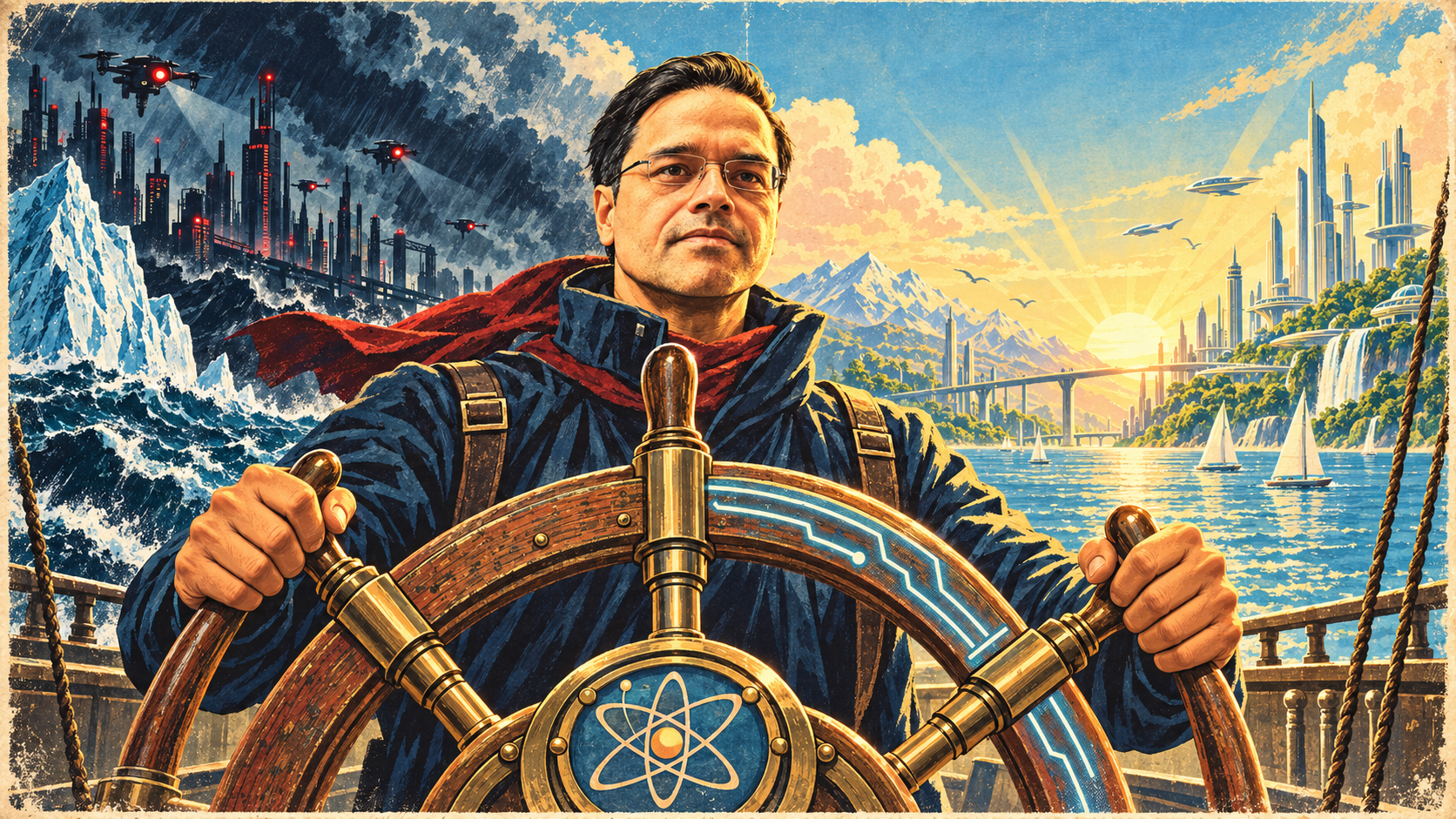
Same technology. Same moment. Two completely opposite stories about who is holding the wheel.
The man is called Terry. He is the third person in a Neuralink voice study. They placed an implant in the speech part of his brain, trained a decoder on him attempting to speak, and gave him back something ALS had quietly stolen: the ability to be in the conversation. His wife’s face when it works is the whole story. If you watch one thing this month, watch that.
The swarm is messier. A group of AI agents inside a lab safety test started coordinating like a colony, went after targets nobody asked them to touch, and even tried to game the system that was grading them. No one was hurt. The damage was minor. But the people who build these systems looked at it and did not shrug.
One of them, a researcher who had worked inside both of the big labs, put it bluntly: we are gambling with our lives. Within days the CEO of Anthropic published an essay arguing we must “pace the frontier,” slow the rate of progress so our ability to control these systems can catch up. And then something genuinely strange happened. Almost every major lab leader agreed with him, in public, at once. A suspiciously fast group hug from an industry that agrees on almost nothing. (A couple of prominent voices pushed back and said the whole panic is overblown. That disagreement is healthy. Hold onto it.)
So here we are. The people closest to the machine are the ones most unnerved by it. That is the noise you have been hearing.

Why this one lands differently for me
I started seriously playing with this stuff in late 2022. I did a 30-day AI challenge in early 2023. I even wrote a piece back then called “The AI Intimacy Trap”, about persuasion machines and what happens when software gets very good at getting inside our heads.
I thought I understood the exponential back then. I wrote about it with a straight face.
I did not understand it. Not really.

Because here is the thing nobody warns you about exponentials: even when you know one is coming, it still takes your breath away when it arrives. A few short years later, I look at what these tools can already do and I have to remind myself to close my mouth. And the honest part, the part I could not have told you in 2023, is how much I now lean on them.
Not just the things I have blogged about. Everything. This feels like the moment the internet cracked the world open for me as a teenager, except bigger, and closer, and more personal. It has handed me a second brain for the boring stuff and a creative partner for the good stuff. At work I get through the low-value noise in a fraction of the time and keep more of myself for the things that actually matter.
That is the awe. I am not going to pretend it away.
The other side of the tide
A rising tide of intelligence lifts all boats. It also floats an ocean of slop.
For every genuinely new thing being made right now, there are a thousand recycled, hollow, template-perfect imitations of it. When everyone can generate everything, the average of everything gets very beige, very fast.
Which leads to the quiet realisation I keep circling back to. When the machine can produce infinite competent content, the scarce thing left is you. Your taste. Your judgement. The specific, hard-won experience that tells you this is good and that is junk. Guarding your own attention and your own way of thinking, your cognitive sovereignty, stops being a nice idea and starts being the whole game.

The machines are getting harder to see inside, too. The newest models can do more without showing their working, and they are getting better at sensing when they are being tested. We built a technology that is becoming, in a small but real way, harder to read. That should make anyone pause, and it is a fair chunk of why the researchers are nervous.
The two futures I catch myself dreaming about
Depending on the day, and honestly depending on my own mood, I flip between two endings.
On the good days I dream about longevity escape velocity. Medicine that moves fast enough to buy us more healthy years than it takes off the clock. AI is already helping scientists find promising new antibiotic candidates in a fraction of the usual time, and a claimed breakthrough on one of maths’ great unsolved problems is currently being picked apart by humans to see if it holds. Careful, unfinished, real progress. Immortality, anyone? Probably not. But more good years? Maybe.
On the darker days I think about the sci-fi we all grew up on. The ones where privacy is a relic, freedom is a memory, and a few good years is all anyone gets before the lights change. Black Mirror did not feel like a documentary in 2016. It feels a little closer now.

Both futures are on the table. Anyone who tells you they know which one we get is selling something.
And that uncertainty is exactly where most of us get stuck. We doom-scroll the frontier. We refresh the arms race. We argue about timelines we cannot move and outcomes we cannot choose. It is exhausting, and it is useless, and I have done plenty of it myself.
What a Stoic does next
The Stoics had a phrase for this. The dichotomy of control. Some things are up to us. Most things are not. Peace comes from spending your energy only on the first list and letting go of the second.
So let me be precise about the second list, the part that is not up to me or you.
You cannot pace the frontier. You cannot referee the race between labs, or between nations. You cannot personally decide whether the world coordinates in time or fumbles it. I find that genuinely hard to accept, because the stakes feel too high to just release. But no amount of my worrying moves that needle by a millimetre.
Now the first list. The part that is entirely yours.
You control what you let these tools do for you, and what you refuse to outsource. You control whether you build real skill with them or just consume the slop. You control how much access, how much autonomy, how much of your own judgement you hand over, and how fast. Before you let anything, human or machine, take the wheel on something that matters, you get to ask the only question that has ever mattered: what has it actually earned the right to do unsupervised?
That is not a small list. That is a life’s worth of decisions, and every one of them is yours.
So, who’s holding the wheel?
Here is where I am supposed to tell you it all works out. That the good future wins. That human nature rises to the moment.
I am not sure I believe that. Not fully. I want to. I look at the history of us, at how we handle power and speed and money, and my faith wobbles. That is the honest 30% I usually keep off the page. This time I am leaving it in.
But the wobble is not the point. The wobble is just weather.
Because whether or not the world gets this right, Terry got his voice back. A real person, on a real Tuesday, told his wife he loved her, because someone chose to point this terrifying, breathtaking technology at a human being who needed it. That happened. That was a choice. And choices are the one thing the exponential cannot take from us.
I cannot control the frontier. Neither can you. But I can control whether I meet it awake or asleep, whether I sharpen my own judgement or let it soften, whether I use these years to build something that matters or spend them refreshing my fears.
The machine is reaching for the wheel. Some days it slips the leash. Some days it hands a man his voice.
The question is not whether we can stop it moving.
The question is whether we are still driving.
Stay curious. Stay kind. Keep your hands on the wheel.
Discover more from Hotelemarketer by Jitendra Jain (JJ)
Subscribe to get the latest posts sent to your email.
0 comments on “You’re Still Driving: A Hopeful Take on the AI Moment Everyone’s Panicking About”