
This week, AI made “impressive” free. It still hasn’t made “right” any cheaper. And that gap is about to decide who wins.
This morning, I fed my entire blog to two of the smartest machines on the planet and asked them to rethink it.
Not tweak it. Not polish it. Reimagine the whole thing.
I handed over the full export, so every story they worked with was real, pulled straight from the site I’ve been writing since 2008. Nothing invented. Then I set them loose.
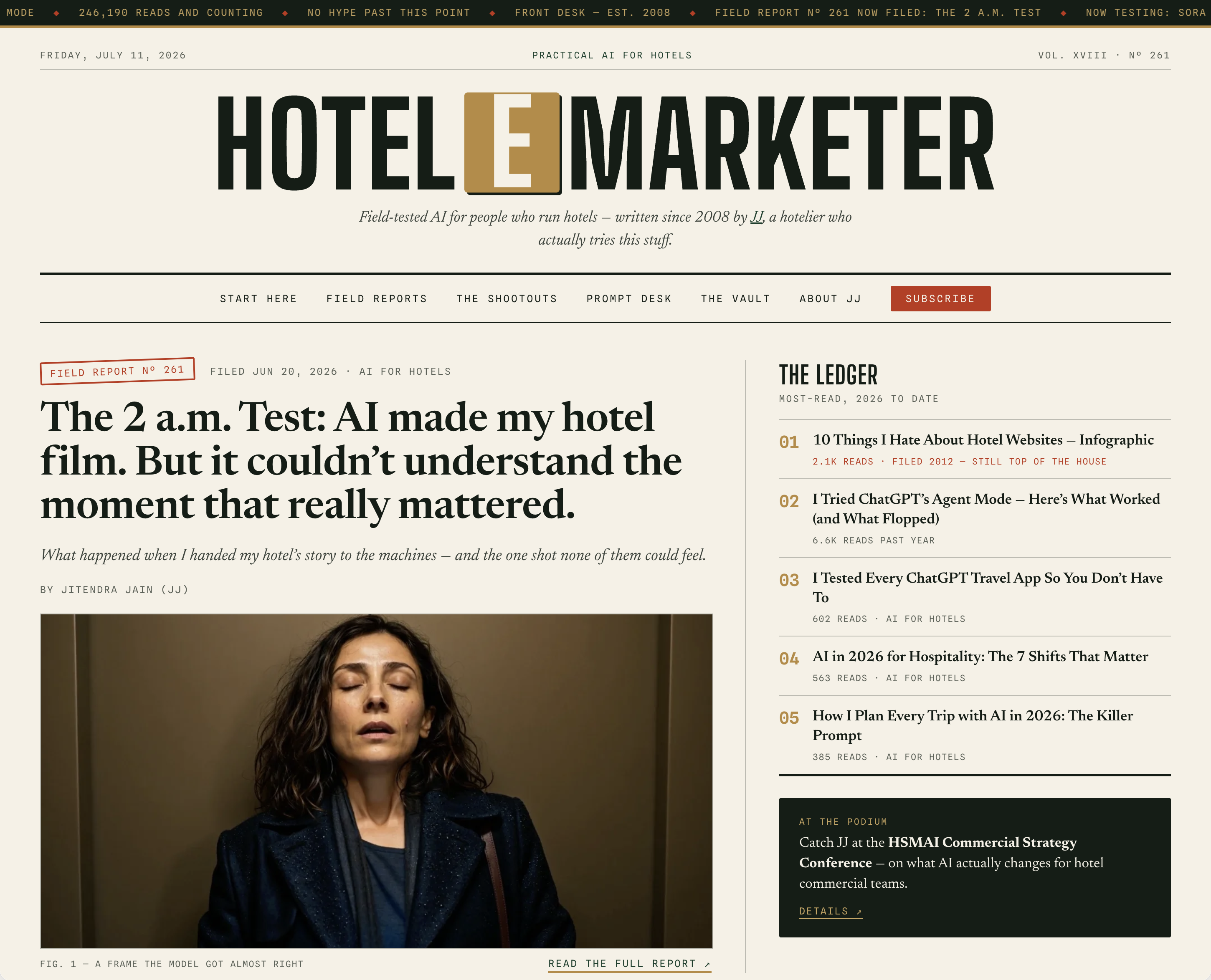
With ChatGPT Work, I used the new Sites feature running on Sol and asked for a functioning site. It built one and hosted the whole thing, no fiddly setup or infrastructure to wrestle with (preview below).

With Claude Design, running Fable, I asked for a front-page mockup. What struck me there was that it asked me questions first, then used the answers to get the design genuinely on point (the hero image for this story).
Twenty minutes later I had two beautiful versions of my blog in front of me. Cleaner layouts. Striking typography. A masthead that looked like a design studio had billed me for six weeks. One even ran a ticker across the top that read “no hype past this point,” which made me smile.
Both were better-looking than the site I’ve been tending for the better part of two decades.
I’m noticing a pattern in how the two differ, as well. ChatGPT is brilliant at churning through a mountain of material and handing back solid, usable, on-point output. Claude is the better collaborator when you’re actually creating something, especially with the right skills guiding it. Different strengths, both genuinely remarkable.
And here’s the honest part. As a first draft, this was extraordinary. As a finished product, it was a mirage.
Where the twenty minutes runs out
Not because the tools failed. They did exactly what I asked. The mirage is that a gorgeous shell looks like a finished thing, and it isn’t one.
To get from that twenty-minute start to a site I’d actually put my name on and release to the world, I’d have to give it the things it can’t guess. My real objectives. My stylistic preferences. Who my audience actually is, what they’re wrestling with, what I want them to walk away able to do. That part is mine. The models can accelerate almost everything around it, but they can’t hold the point of view for me.
The twenty minutes gets you the shell. The substance is still the human part.
And this is where I get a little uneasy. Because plenty of people won’t stop where I did. They’ll take the twenty-minute output and ship it straight to the world. The result is a rising tide of intelligent-looking content with very little underneath it, no real grounding in how people actually work, what actually moves them, or what creates genuine impact or change. It looks like insight. It’s closer to set dressing.
If you’ve watched a vibe-coded app come apart the moment you try to deploy or scale it, you know the feeling. The demo dazzles. Then real life starts asking the harder questions.
I’m not telling you any of this to knock the tools. I use them every day and I’m genuinely in awe of them. I’m telling you because this morning’s experiment is, I think, the whole story of where we are right now, compressed into twenty minutes.
Capability just became free
It has been an astonishing few weeks. Anthropic released Fable, a model built to work on its own for hours at a stretch. OpenAI shipped 5.6 and a new “work” super-app that reads your files, runs your errands, and keeps going after you close your laptop. Agentic AI has already rattled markets once this year: a single launch poured fuel on the disruption-fear trade and wiped roughly $285 billion off parts of the software sector.
Strip away the benchmark noise and one thing matters for the rest of us. Raw capability just became almost free, and almost instant.
A polished 3D game for 77 cents. A website in twenty minutes. A board-ready deck while you’re still in the lift. The thing that used to take a team and a budget now takes a sentence and a little patience.
Which sounds like the best news imaginable. And it is, as long as you catch the twist.
Why “impressive” stopped meaning anything
The twist is that impressive just quietly died as a signal.
For most of my career, impressive was reliable. If something looked polished, someone skilled had sweated over it. Effort and quality travelled together, so “looks good” was a fair proxy for “is good.” That link is now broken. Anyone can generate brilliant-looking output on any topic, in any style, before the kettle boils.
So the question flips. The old test was whether you could make something impressive. Everyone can now. The real test is whether you can tell if the impressive thing in front of you is actually any good.
That is a judgment problem. And judgment hasn’t gotten cheaper. If anything, it just became the whole game.
The trap nobody warns you about
Here’s the part I wasn’t expecting. I assumed AI would reduce my mental load. Sometimes it does the opposite.
I’ve just started a demanding new role. Twelve and fourteen-hour days are not unusual right now. Information arrives faster than I can file it. And yes, I lean on AI more than I ever have. Copilot at work has genuinely earned its name lately. It helps me turn a firehose of meetings and messages into themes I can actually act on. I’ll even feed it a transcript of my own thinking to sense-check whether I’m on the right track, or whether I’ve talked myself into a confident position with a hole in the middle of it. Used that way, it really is a co-pilot.
But I’ve also learned to watch for the trap. Bad, lazy AI use is obvious. Everyone can spot the soulless wall of generated text. The sneakier problem is good-looking AI use. Point a capable model at a vague question and it hands you something intelligent, thorough, and expansive. More analysis. More options. More things to consider. More meetings to have about the things to consider.
You feel productive. You’re actually just manufacturing more surface area to manage.
The skill nobody teaches is subtraction. Asking the machine to narrow rather than widen. To cut five options to two. To tell you what to ignore. To point out where you’re being reactive instead of decisive. The most useful prompt I’ve written all year wasn’t “give me more.” It was closer to “what am I missing, and what should I drop.”
Fast is cheap now. Direction isn’t.
I said something on Mona’s Unlocking Potential podcast (Apple / Spotify) recently that I keep coming back to. The cost of moving fast in the wrong direction has never been higher. When you can execute a bad idea beautifully in an afternoon, speed stops protecting you. It just delivers you to the wrong place faster, with better fonts.
The flip side is the hopeful bit, and it’s why I still bet the way I do. The reward for moving fast in the right direction has never been higher either. Same engine, opposite outcomes. The only thing that decides which one you get is your judgment about where to point it.
The new two speeds
A while back I wrote that AI was moving at two speeds. One speed for whoever could reach (and pay for) the frontier tools, and a slower, more nerfed one for most people inside big organisations. That gap was about access.
Access is closing fast. Frontier-class power is landing in everyone’s hands, on their phones, for pocket change. Which means a new two-speed gap is opening, and it’s a harder one to cross. Not who has the best tools. Who has the best taste for using them. The first gap you could buy your way over. This one you have to earn.
The thing actually worth protecting
Which brings me to what I genuinely worry about. Not the machines. Us.
If we let AI do our thinking instead of sharpening it, we don’t get smarter. We get a beautifully rendered version of dumber. There’s a film, Idiocracy, that I won’t spoil beyond saying it’s a comedy that gets less funny the more of the news you read. The road there isn’t evil robots. It’s ordinary, capable people quietly handing over their judgment, one convenient answer at a time, until nobody quite remembers how to check the work.

I don’t believe that’s our fate. (The optimist in me never fully shuts up.) But avoiding it isn’t automatic. It’s a choice you make in small moments, over and over.
I’ve started calling the thing worth guarding cognitive sovereignty (credit to Mona for raising the idea on our podcast). Staying the author of your own thinking, even while you accept enormous help writing it down. Letting AI expand what you can do without letting it quietly annex your judgment about what’s worth doing.
What this looks like in practice
So, less manifesto, more real life. What does that actually look like?
It looks like treating every impressive AI output as a first draft, never a verdict. Being the person in the room who asks the second question, the one that checks whether the shiny thing holds up. Using the machine to widen your options, then doing the harder, human work of narrowing them yourself. Pointing all this astonishing horsepower at the right problem before you fall in love with how fast it moves.
The teams that win the next few years won’t be the ones that generate the most. Everyone can generate now. They’ll be the ones with the taste to know what’s worth generating, and the nerve to throw most of it away.
My twenty-minute website really was beautiful. I’m probably going to build a version of it, slowly, with my hands on the wheel and my judgment in the loop.
Because the mirage isn’t a lie. It’s a promise the machine can’t keep on its own. It shows you what’s possible, then quietly hands you the part it can’t do: deciding what’s actually worth building, and whether the beautiful thing in front of you is true.
That part is still yours. Guard it like it’s the last scarce resource.
Increasingly, it is.
Discover more from Hotelemarketer by Jitendra Jain (JJ)
Subscribe to get the latest posts sent to your email.
Pingback: You're Still Driving: A Hopeful Take on the AI Moment Everyone's Panicking About - Hotelemarketer by Jitendra Jain (JJ)